





By Simeon Shodimu

As Nigeria continues its search for sustainable pathways to food security, agribusiness expansion and rural economic development, a new generation of agricultural firms is gradually redefining farming beyond the traditional hoe-and-cutlass model. Increasingly, agriculture is becoming a structured business driven by technical expertise, mechanisation, land management systems, agribusiness consultancy and modern production strategies designed to improve profitability and long-term sustainability.
Among the emerging players shaping this transition is Flip Farm Resort an Ogun State-based agribusiness and farm real estate company steadily positioning itself as a technical and operational force within Nigeria’s evolving agricultural landscape.
Founded on the philosophy that agriculture must move from subsistence activity to structured commercial enterprise, Flip Farm Resort combines farmland development, farm management, agricultural investment, crop production and agribusiness training into a broad operational framework aimed at strengthening food production while creating wealth opportunities for farmers and investors alike.

The company’s activities span farmland acquisition and development, mechanised farming support, agribusiness advisory services, crop cultivation and youth-focused agricultural empowerment programmes. At a time when investors are increasingly seeking professionally managed agricultural ventures, Flip Farm Resort is building its reputation around technical coordination, operational management and practical farming expertise.
According to information published on the company’s platform, Flip Farm Resort seeks to acquire and manage high-quality farmland across Nigeria to meet growing demand for food, feed and fibre while supporting entrepreneurship and agricultural expansion.
Its operational footprint currently stretches across several locations including Awowo in Ewekoro Local Government Area of Ogun State, Epe, Ijebu and Abeokuta, with expansion interests extending toward Oyo and Ilorin. The company says its farmlands are strategically selected based on soil suitability, agricultural viability and safety considerations necessary for commercial farming operations.
What distinguishes Flip Farm Resort from conventional farmland marketers is its growing emphasis on integrated agribusiness solutions rather than land transactions alone. Beyond selling farmland, the company has increasingly positioned itself within broader agricultural management systems involving farm setup, cultivation support, agronomic supervision, mechanisation and production coordination.
The company’s crop production portfolio currently includes maize, cassava and aquaculture operations, particularly catfish farming, while its agribusiness structure also incorporates farm investment management and agricultural consultancy services.
Industry analysts note that Nigeria’s agricultural sector is gradually witnessing the emergence of firms that function as technical partners capable of handling end-to-end farm execution for investors and commercial farmers. These services often include soil analysis, crop planning, irrigation systems, mechanisation, field monitoring, harvest coordination and market integration.
Globally, modern farm management models are increasingly recognised as critical components of commercial agriculture because they reduce operational inefficiencies while improving productivity, scalability and sustainability. Similar agribusiness management structures now operate across emerging agricultural markets where professional firms oversee technical execution on behalf of investors and farm owners.
For Flip Farm Resort, technical coordination appears central to its operational philosophy. The company’s emphasis on mechanised farming, farmland readiness, structured cultivation and agribusiness support reflects a growing recognition that modern agriculture requires more than access to land alone.
Speaking in an interview published on the company’s website, the Managing Director and Chief Executive Officer, Jide Akinseye, explained that the company’s agricultural expansion was inspired by the need to combine real estate investment with practical farming opportunities capable of delivering long-term value.
flipfarmsresort.com.ng
According to him, Flip Farm Resort began expanding aggressively after acquiring large expanses of farmland in Ogun State, where the company combined agricultural production with farmland investment schemes designed to encourage broader participation in farming activities.
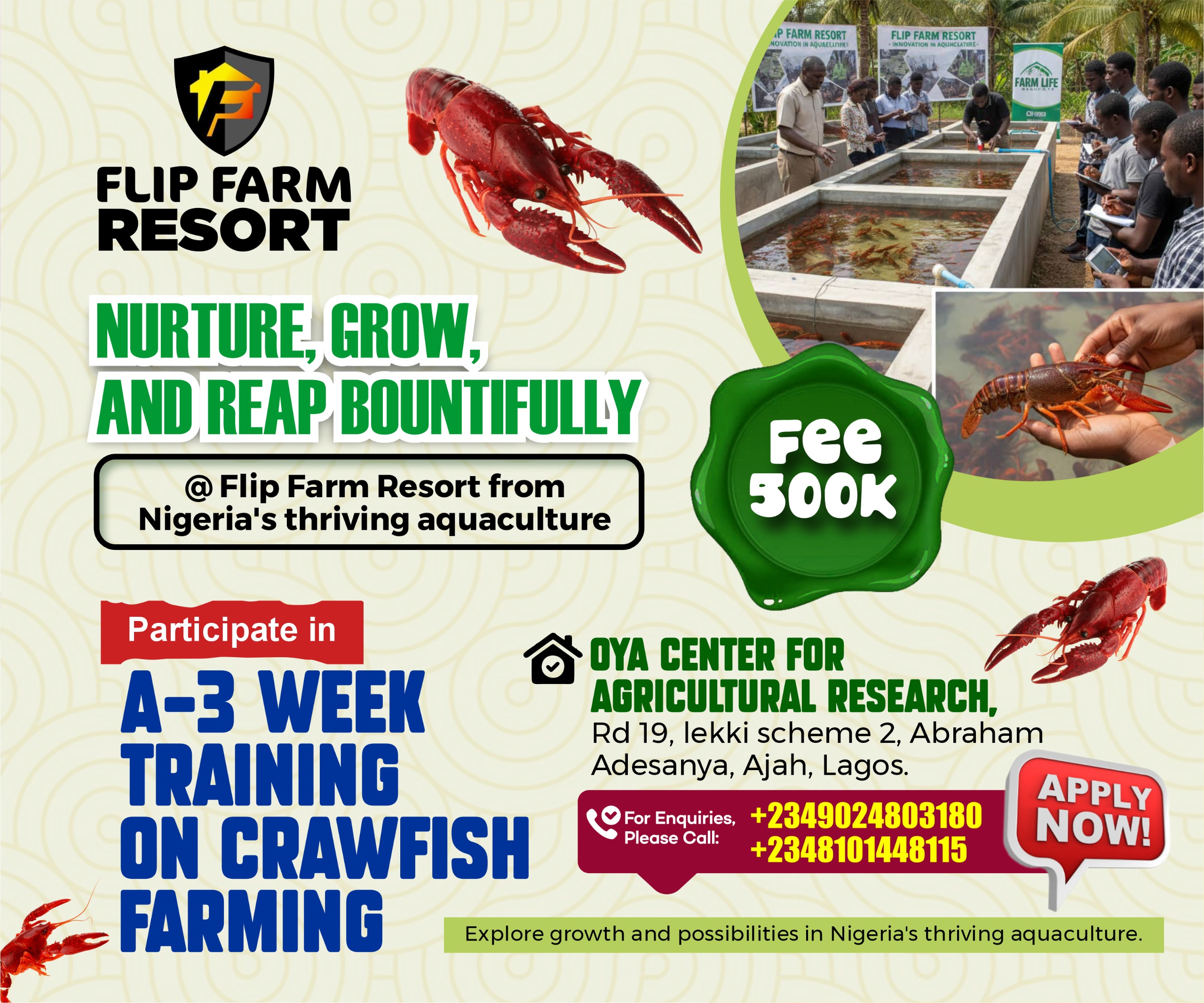
The company’s growing visibility within the agribusiness ecosystem is also linked to its youth empowerment and agricultural training initiative known as Opportunities for Youth in Agriculture (OYA). The programme focuses on equipping young Nigerians with practical knowledge in agroforestry, aquaculture, vegetable production, snail farming, piggery and agribusiness management.
Under the initiative, participants undergo practical field training, internship and mentorship programmes aimed at building technical competence and entrepreneurial capacity within the agricultural sector. The programme also incorporates farm management exposure, agribusiness orientation and practical production systems intended to prepare participants for commercial agriculture.
Industry stakeholders believe such interventions could help address one of Nigeria’s major agricultural challenges — the shortage of technically skilled young agripreneurs capable of driving large-scale commercial farming operations.
Nigeria’s agricultural sector currently contributes significantly to national GDP, yet experts maintain that productivity remains below potential due largely to poor mechanisation, inadequate technical support systems, weak value chains and limited access to structured farm management. Agribusiness firms capable of bridging these operational gaps are therefore becoming increasingly important within the sector’s transformation agenda.
Beyond production itself, Flip Farm Resort is also leveraging agricultural real estate as an investment model, promoting farmland ownership as a long-term asset capable of generating both agricultural returns and land appreciation value. The company describes farmland as a strategic investment vehicle with strong growth fundamentals tied to increasing food demand and agricultural expansion.
Observers say the convergence of farmland investment, technical farm management and agribusiness consultancy may become increasingly attractive as more Nigerians explore agriculture not merely as subsistence activity, but as a structured commercial venture.
Within this evolving landscape, Flip Farm Resort is steadily positioning itself as more than a farmland company. Through its expanding focus on technical execution, mechanised agriculture, agribusiness development and human capital training, the company is carving a niche as a modern agricultural management platform seeking to align farming with professionalism, sustainability and commercial growth.
At a time when Nigeria continues to search for practical solutions to food insecurity, unemployment and agricultural underperformance, firms that combine technical expertise with structured agribusiness systems may ultimately play a defining role in shaping the future of commercial agriculture.