




By Shewa Falade

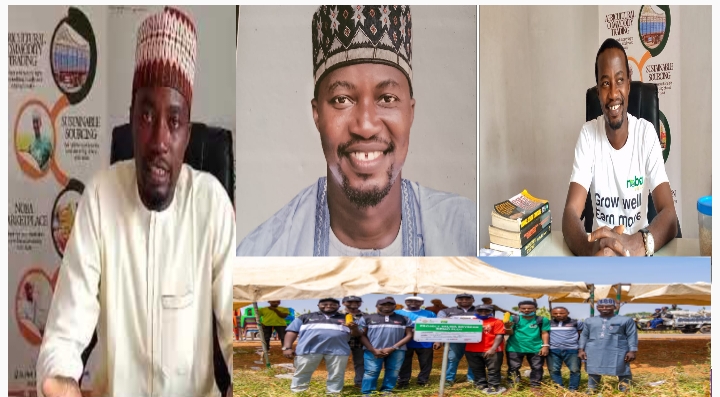
Despite growing attention to agriculture as a cornerstone of Nigeria’s economic recovery, deep-rooted structural challenges continue to limit the sector’s full potential. In this interview with FARMLIFE MEDIA, the Founder and Chief Executive Officer of NOBA AFRICA AGRO ALLIED LIMITED – ABDULRAZAK NAJIM, speaks on policy gaps, market instability, insecurity, and the urgent reforms needed to drive productivity and achieve food sufficiency.
Kindly introduce yourself and provide a brief overview of your organization and its role within the agricultural sector.
I am Abdulrazak Najim, the Founder and CEO of Noba Africa Agro Allied Limited, a Nigeria-based agribusiness focused on transforming agricultural value chains across Africa.
We operate across commodity trading, seed development, and agricultural project management. We aggregate crops like maize, soybeans, sesame, and rice, linking smallholder farmers to reliable markets. At the same time, we develop climate-resilient seeds to boost productivity, while our consultancy arm supports agricultural projects with execution and value chain expertise.
Our goal is simple: bridge the gap between farmers and markets, improve productivity, and contribute to food security and economic growth.

In which locations across Nigeria does your organization currently operate?
We currently operate in Niger, Kaduna, and Nasarawa states.
What core values have guided your organization’s growth?
Our work is anchored on farmer-centricity, integrity, disciplined execution, and value chain integration. We also prioritize innovation and sustainability—ensuring that everything we do improves productivity, increases farmer incomes, and builds a commercially viable system.
What key innovations or strategies have you introduced to improve efficiency?
We have developed an integrated value chain model that connects input supply, aggregation, and market access. We’re also building structured sourcing networks instead of relying on open markets, which improves reliability and reduces volatility.
Additionally, our seed-led productivity strategy focuses on high-quality, climate-resilient seeds.
We align production with actual market demand to reduce post-harvest losses, and we are gradually incorporating data into decision-making for better forecasting and efficiency.
What are the major challenges government needs to address to enhance productivity?
The biggest issues are insecurity in farming regions, poor access to appropriate financing, policy inconsistency, weak market regulation, and infrastructure gaps.
Insecurity alone is shrinking the agricultural space, while unstable policies disrupt the entire value chain. Without fixing these fundamentals, productivity will remain constrained.
How effective have government policies been in addressing the high cost of farm inputs?
Government efforts exist, but they are limited in impact. The real issue is not just input cost—it’s output pricing.
Farmers are struggling to sell their produce profitably. So even when inputs are subsidized, the economics don’t work. What we need is a holistic approach that includes price stabilization, structured offtake systems, and stronger market regulation.
Is the government getting its priorities right on food security?
The intent is there, but execution is inconsistent. Frequent policy changes create uncertainty, making it difficult for farmers and investors to plan.
Agriculture requires long-term commitment. If policies are stable, the private sector will respond and scale accordingly.
What is your assessment of the current administration’s agricultural policies?
I would rate it as moderate. There is clear effort, but inconsistency remains a major issue.
There has been increased attention to agriculture and some financing interventions, but the lack of policy continuity and alignment with market realities continues to limit impact.
How well is the government addressing insecurity affecting agriculture?
There are visible efforts, but they are not yet sufficient. Insecurity continues to disrupt farming activities, reduce production, and increase food prices.
Beyond military action, we need stronger local intelligence, protection of farming corridors, and faster response systems. Without security, food security is impossible.
What are your future plans toward achieving food sufficiency in Nigeria?
Our focus is on scaling both productivity and production.
We are investing in climate-resilient seeds, supporting farmers with training and market access, and building market-driven production systems. We also plan to expand across key agricultural belts and strengthen coordination across the value chain.
Ultimately, our goal is to help farmers produce more efficiently and sustainably, which is critical to building a food-secure Nigeria.