




By: Lanre Shodimu

In an innovative effort to deepen conversations around sustainable agriculture and encourage a more holistic approach to farming, Farmlife Media, in collaboration with Brahma Kumaris Nigeria, has concluded a one-day retreat that brought together young Nigerian farmers and experts from India for an insightful exploration of farming, spirituality and human values.The much-anticipated retreat, held under the theme “Cultivating the Land with Spiritual Power, Sustainable Wisdom & Human Values,” introduced participants to the concept of Yogi Farming—an approach that seeks to connect agricultural practice with inner peace, positive consciousness, responsibility, gratitude and a deeper relationship with nature.The gathering provided an unusual but thought-provoking platform for farmers and agropreneurs to examine agriculture beyond production, profit and physical labour, while exploring how the mindset and emotional state of a farmer can influence decision-making, relationships with nature and responses to the challenges of farming.
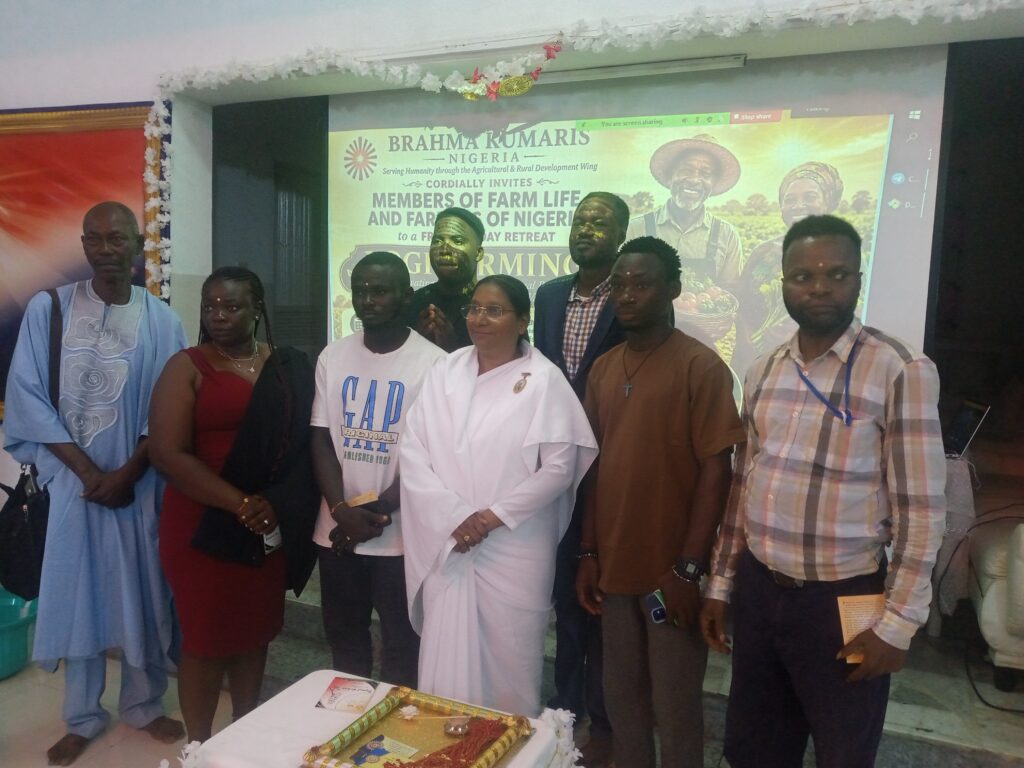
The retreat also featured lectures, interactive sessions, meditation and practical reflections led by experts associated with Brahma Kumaris, including an Indian expert who challenged participants to rethink the traditional understanding of the farmer.‘Before cultivating the land, cultivate yourself’One of the central messages of the retreat was that agricultural transformation must begin with the transformation of the farmer.
The lead speaker explained that farming is not merely about cultivating soil, planting seeds and harvesting crops, but also about cultivating the consciousness of the person responsible for the farm.According to the speaker, every action begins with a thought, and every thought has consequences.He described this as a continuous chain of “cause and effect,” stressing that farmers must therefore pay attention to the quality of their thoughts because those thoughts ultimately influence their attitudes, actions and results.

“Before I cultivate the land, I cultivate myself,” he said, describing the principle as one of the key foundations of Yogi Farming.He explained that a farmer who enters the farm with anger, fear, confusion or hopelessness may approach challenges differently from one who operates from a position of peace, patience, determination and clarity.

The speaker urged farmers to learn to distinguish between circumstances beyond their control and their personal responses to those circumstances.“Circumstances are real, but how I respond to them is within my influence,” he noted.For him, changing consciousness does not mean ignoring the realities confronting farmers. Rather, it means developing the mental and emotional capacity to respond to those realities constructively.Five virtues of a Yogi Farmer.A major part of the session focused on virtues considered essential to the Yogi Farmer.These included peace, patience, determination, appreciation and gratitude with responsibility.Peace, participants were told, enables farmers to think clearly before making important decisions.Patience, on the other hand, is necessary because agriculture operates according to natural processes that cannot always be hurried.“Crops cannot be forced to grow overnight,” the speaker reminded participants, encouraging farmers to cultivate patience alongside their crops.Determination was identified as the ability to continue despite setbacks.Farmers were encouraged not to develop what the speaker described as a “victim consciousness” when confronted with difficulties such as crop failure, weather challenges, pests, diseases or market instability.Instead, they were urged to prepare mentally for challenges and remain committed to finding solutions.The third principle was appreciation—a conscious recognition of the importance of soil, water, sunlight, seeds, animals and the people who contribute to the agricultural ecosystem.The session also emphasised gratitude and responsibility, with the speaker encouraging farmers to view agriculture not only as a business but also as a service to society.Farming as service to humanity.According to the speakers, the significance of farming goes beyond financial returns.A farmer produces food that sustains individuals, families and communities, making agriculture one of the most fundamental services to humanity.The retreat therefore encouraged participants to see themselves not simply as producers seeking income, but as providers contributing to the wellbeing of society.“A farmer does not only cultivate the soil. A farmer cultivates life, food, family and society,” the speaker said.The message resonated with the broader objective of the retreat—to encourage farmers to see agriculture as a profession with social, environmental and human dimensions.The seven qualities within every individualAnother major session examined the concept of human consciousness and the seven inherent qualities believed to exist within every individual.The qualities identified were peace, love, happiness, knowledge, power, purity and bliss.The speakers explained that while these qualities may exist within people, they are not always consciously expressed.The challenge, they said, is to learn how to bring these qualities into awareness and allow them to influence everyday decisions and actions.The session presented the farmer as more than a physical worker operating on the land, but as a person whose thoughts, attitudes and values can shape his or her approach to agriculture.Participants were encouraged to develop a consciousness that is peaceful, positive and purposeful before commencing agricultural activities.From farmer consciousness to Yogi Farmer consciousnessThe retreat drew a distinction between what was described as ordinary farmer consciousness and Yogi Farmer consciousness.An ordinary response to excessive rainfall, crop failure, rising costs or other agricultural challenges may be dominated by fear, frustration and blame.The Yogi Farmer, however, is encouraged to acknowledge the difficulty while maintaining inner stability and focusing on constructive responses.The speaker explained that uncertainty is an unavoidable part of agriculture, citing challenges including unpredictable weather, rising input costs, pests and diseases, labour shortages, market difficulties and crop losses.Rather than allowing these challenges to create hopelessness, farmers were encouraged to cultivate what the speakers described as “peace and strength” within themselves.The philosophy does not suggest that farmers should ignore practical agricultural realities. Instead, it encourages them to combine practical knowledge with mental resilience, positive thinking and responsible decision-making.Meditation and the farmer’s inner lifeOne of the distinctive moments of the retreat was a guided meditation session designed to help participants pause from the demands of agricultural work and reconnect with themselves.Participants were encouraged to quietly reflect on affirmations such as:“I am a peaceful soul.”“I am not only a farmer.”“I am a soul performing the role of a farmer.”“I am stable, peaceful and courageous.”“I bring peace into my thoughts.”“I bring patience into my actions.”“I bring love and respect into my relationships with nature.”The exercise was presented as a reminder that farmers, like everyone else, need moments of reflection amid the demands of work.The speaker observed that farmers can become consumed by the cycle of working continuously without taking time to examine their thoughts and emotional state.According to the philosophy presented at the retreat, creating space for inner reflection can help farmers make clearer decisions, manage stress and approach their work with greater patience and responsibility.‘Healthy soil, healthy crops and healthy farmer’Another key message from the retreat was the relationship between the health of the farmer and the health of the agricultural environment.The speakers repeatedly returned to the idea that sustainable agriculture requires attention not only to soil and crops but also to the person cultivating them.“Begin with a healthy consciousness,” one of the speakers told participants, linking the concept to the broader idea of healthy soil, healthy crops and a healthy farmer.The retreat also encouraged participants to experiment with the principles in practical farming situations rather than simply treating them as theoretical ideas.Farmers were challenged to observe how their attitudes, approaches and relationships with their environment affect their experiences on the farm.Sustainable wisdom for a changing agricultural landscapeBeyond spirituality, the retreat also addressed the broader question of sustainability.Participants were encouraged to develop a deeper relationship with nature and recognise the importance of responsible interaction with the environment.The speakers described soil, water, air, sunlight and seeds as essential tools in the farmer’s work and urged participants not to approach nature solely from a position of exploitation.Instead, farmers were encouraged to develop an attitude of appreciation and responsibility towards the resources that sustain agricultural production.The concept of Yogi Farming, as presented at the retreat, therefore seeks to combine agricultural knowledge, sustainability, spirituality and human values into a broader philosophy of farming.A new perspective for young farmersFor the young Nigerian farmers who attended, the retreat offered an opportunity to consider agriculture from a perspective that is rarely discussed in conventional farming conversations.The focus was not on replacing modern agricultural techniques, technology, farm management or scientific knowledge, but on complementing them with values such as patience, peace, determination, gratitude and responsibility.The underlying message was simple: the farmer’s state of mind matters.When farmers are able to manage their thoughts, emotions and responses to difficult situations, they may be better positioned to make sound decisions and navigate the uncertainties associated with agriculture.Farmlife’s expanding role in agricultural advocacyThe retreat also forms part of Farmlife Media’s broader efforts to create platforms that promote agricultural development, knowledge sharing and meaningful conversations among farmers, agropreneurs and stakeholders across Nigeria.By bringing together Nigerian farmers and international experts, the initiative created room for cultural exchange and the sharing of perspectives on agriculture and human development.For Farmlife Media, the conversation around agriculture extends beyond food production to include the people who cultivate the land, the communities they serve and the values that shape the agricultural sector.Cultivating the futureAs the retreat came to a close, one message stood out: agriculture begins with the farmer.The soil may provide the foundation, seeds may provide potential, water and sunlight may support growth, and technology may improve efficiency—but the farmer remains central to the process.The Yogi Farming retreat challenged participants to consider that before asking how to produce more, farmers should also ask how they can become better custodians of the land and better contributors to society.Its philosophy can be summed up in one powerful principle: cultivate yourself before you cultivate the land.For Nigeria, where agriculture remains central to food security, employment and rural development, initiatives that encourage farmers to combine technical knowledge with resilience, responsibility and sustainable values could contribute to a more holistic conversation about the future of farming.The retreat may have lasted only one day, but its message was designed to extend far beyond the venue—to the farms, communities and lives of the farmers who participated.Ultimately, Yogi Farming is an invitation to see farming not merely as a means of producing food, but as an opportunity to cultivate life, nurture nature, serve humanity and build a more sustainable future—one farmer, one farm and one thoughtful action at a time.