


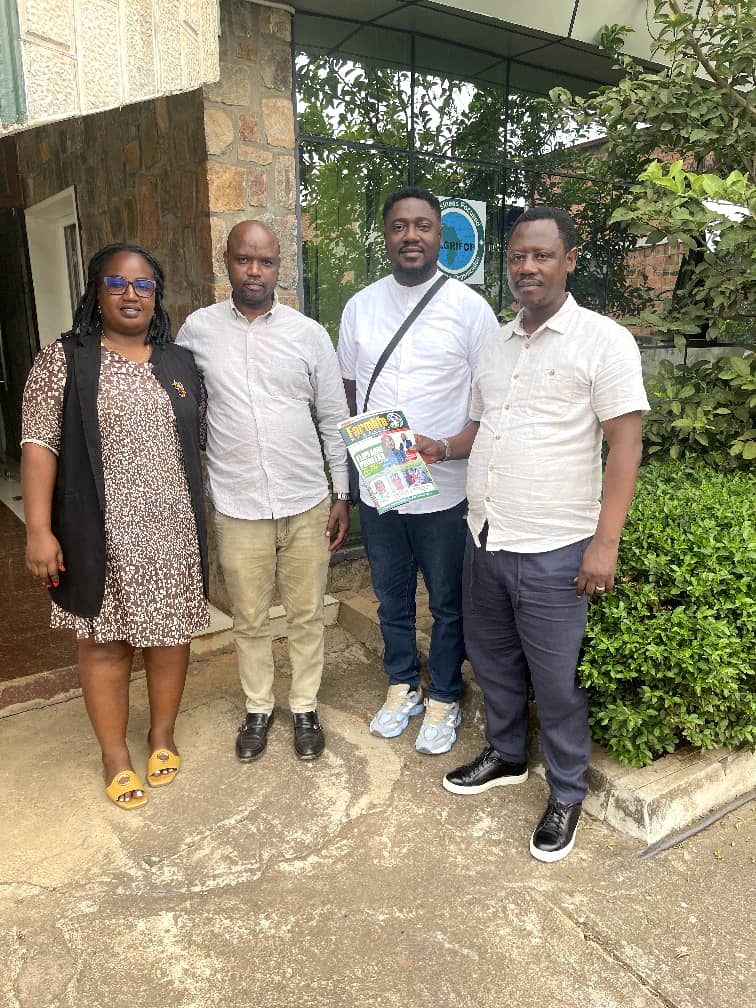
In this insightful interview, Farmlife engages AGRIFOP Rwanda CEO; Jean Bosco Safari on Agricultural Development, Food Safety and Farmer Support Systems.

Farmlife Media: Thank you for speaking with us. To begin, can you tell us about AGRIFOP Rwanda and the work your organisation does with farmers?
AGRIFOP CEO: Thank you. We have been working with agro-dealers and farmers since 2012. Our focus has been on promoting the use of improved seeds, fertilizers, and the safe use of agricultural inputs such as pesticides and fungicides. We support farmers in accessing markets, finance, and agricultural technologies through partnerships with major suppliers, agro-dealers, distributors, and farmer cooperatives.

In addition, we place strong emphasis on food safety. We want to ensure that the food produced is safe and meets both local and international standards.
Farmlife Media: How do you ensure that farmers meet those standards?
AGRIFOP CEO: We conduct regular training sessions, establish demonstration plots, organize farmer field days, and provide in-house technical training. We teach farmers about modern agricultural technologies, good agricultural practices, pest management, and the safe use of agricultural inputs.
We also educate them about pesticide residues and the importance of using only approved products. If unacceptable residues are found, products may be rejected in the market, especially for export. Therefore, our goal is not only to support exports but also to ensure that food consumed locally is safe.
Farmlife Media: We understand that Rwanda is developing a wholesale market system. What role is AGRIFOP playing in that process?
AGRIFOP CEO: Rwanda, together with the European Union, is working on establishing a wholesale market where products must be traceable and certified. AGRIFOP is supporting the food safety chain from production to market.
We work with farmers from land preparation, planting, pest management, harvesting, packaging, and transportation to ensure that products reach consumers safely and in compliance with standards.
Farmlife Media: Apart from food safety, are there other value-chain projects you are involved in?
AGRIFOP CEO: Yes. We are also working with GAIN Rwanda on the development of the high-iron bean value chain. In the past, we have collaborated with AGRA and USAID on fertilizer use, cross-border trade, and agribusiness development.
Our overall aim is to build a strong agribusiness ecosystem where farmers benefit economically and consumers have access to safe food.
Farmlife Media: What makes AGRIFOP different from many other agricultural support organisations?
AGRIFOP CEO: One key difference is that we work with both farmers and agro-dealers. We believe that the partnership between these two groups is essential for agricultural development.
Farmers depend on agro-dealers for seeds, fertilizers, and pesticides. If the agro-dealer has the right technical knowledge, the farmer receives correct advice. We therefore train both parties.
For farmers, we focus on productivity and good agricultural practices. For agro-dealers, we focus on technical knowledge and customer advisory services beyond simply selling products.
Farmlife Media: What lessons can other African countries learn from this model?
AGRIFOP CEO: They can learn the importance of building an institution that supports the entire agricultural ecosystem. Good agricultural practices alone are not enough if farmers cannot access quality inputs. Likewise, quality inputs are not enough if farmers do not know how to use them.
Agro-dealers must be honest suppliers and capable advisers. We train them to understand product labels, dosages, timing of application, and safety requirements so they can guide farmers properly.
Farmlife Media: Is AGRIFOP a government agency?
AGRIFOP CEO: No.
AGRIFOP is a local non-governmental organisation.
Farmlife Media: Where does your funding come from?
AGRIFOP CEO: We receive funding from different development partners. For example, the European Union supports our food safety work, while GAIN supports the high-iron bean programme. Different projects are funded by different partners.
Farmlife Media: Are your activities limited to Rwanda?
AGRIFOP CEO: No. We are open to operating wherever opportunities exist. Between 2018 and 2020, we implemented an OECD-supported project in Rwanda, Uganda, Tanzania, Burundi, and later the Democratic Republic of Congo. So we have experience working across five countries.
Farmlife Media: We would certainly like to see AGRIFOP in Nigeria, especially as agriculture is becoming a major national priority. What has been the impact of your interventions on crop yields?
AGRIFOP CEO: The impact varies by crop. Take maize as an example. If a farmer uses ordinary open-pollinated seeds, yields are relatively low. But when the farmer uses hybrid seeds, proper fertilization, effective pest control, and follows good agricultural practices, yields can increase significantly.
The results come from combining improved inputs with correct management practices.
Farmlife Media: What would determine your expansion into countries such as Nigeria?
AGRIFOP CEO: Expansion depends largely on partnerships and funding. We implement projects financed by development partners. If organisations such as USAID, the European Union, DFID, embassies, or even a national ministry are interested, we can develop a proposal and work together.
Farmlife Media: So AGRIFOP does not sell agricultural products directly?
AGRIFOP CEO: No, we do not sell products. We provide technical knowledge, business linkages, and project implementation services. We develop project ideas, present them to funding partners, and if they approve them, we implement the projects using their support.
Farmlife Media: Finally, from the Rwandan experience, what would be the first step for a country like Nigeria to attract this kind of collaboration?
AGRIFOP CEO: The first step is building partnerships between the Ministry of Agriculture and development partners. Once there is a clear agricultural priority and funding commitment, organisations like ours can provide technical ideas and implementation support. If the proposal is accepted, then the collaboration can move forward.
Farmlife Media: Thank you very much for sharing these insights with us.
AGRIFOP CEO: Thank you. It was a pleasure speaking with you.