

By: Simeon Shodimu

The Federal Government as part of its on going efforts and commitment to at driving agrifood is set to ti domesticate CAAP.
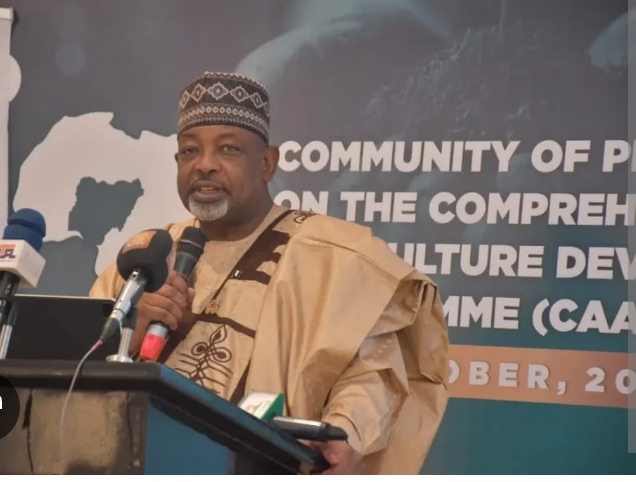
The minister of agriculture, Abba Kyari made this known in his address of welcome at the National Validation of the Agricfood Systems Strategy and Plan for Implementation of the Comprehensive Africa Agricultural Development Programme, CAADP, Kampala Declaration (2026-2035), held in Abuja.

The minister recalled that over two decades ago, the African Union Head of State and Government adopted the Maputo Declaration and established the Comprehensive Africa Agriculture Development Programme, CAADP, as the continent’s flagship framework for agricultural transformation, which set a target of allocating at least 10 per cent of national budgets to agriculture and aimed for six per cent of annual agricultural growth while describing it as “historic and a bold declaration of intent, signalling that Africa would no longer accept food insecurity as its destiny.
He commended stakeholders present at the agrifood system, and stated that their unity by a shared purpose focused on building a resilient, inclusive, and investment-ready agriculture sector for Nigeria.
“Today, the CAADP Kampala Declaration renews that commitment for the decade ahead. It builds on the foundations laid by Maputo and Malabo, but it goes further. It challenges us to move beyond production targets to embrace a holistic, agrifood systems-based approach that addresses value chain development, resilience, inclusivity and good governance.
“To contextualise and domesticate the Kampala Declaration, Mr. President directed that we develop an Agrifood System Strategy and Action Plan for Nigeria. Upon receiving this presidential directive, I immediately set up a Technical Committee comprising experts from across the agricultural value chain, academia, research institutions, development partners, and the private sector.
“Their mandate was clear: develop a zero draft that would enable stakeholders to view, interrogate, and ultimately buy into the vision.5. In this regard, the plan has undergone extensive stages of consultation across all six (6) geopolitical zones, as well as a national-level consultative workshop. At each of these fora, stakeholders provided invaluable inputs derived from their unique regional contexts, shared areas of comparative advantage, and lived realities.
“The essence of this wide consultation has been to ensure that inputs are derived from the sub-regions to include their shared areas of comparative advantage.
“We wanted a plan that reflects the diversity of Nigeria’s agricultural landscape, from the livestock corridors of the North to the aquaculture belts of the South, from the cassava and yam zones of the East to the cocoa and oil palm plantations of the West.
“To further integrate and consolidate the inputs collated into the plan, we recognised the need for this national validation meeting, which is the reason why we are here today.”
Meanwhile, the Minister maintained that, “Nigeria’s agrifood system is central to our national development agenda. It supports the livelihoods of over 70 per cent of our population, drives our rural economies, contributes significantly to our GDP, and holds immense potential for job creation, foreign exchange, and inclusive growth. When our agrifood system thrives, Nigeria thrives.” He said .
Speaking further , he said, “we cannot and will not validate a document that ignores our stark realities. We are here because we recognise that the sector continues to face challenges associated with climate change vulnerability.
“These challenges are not just bullet points; they are the barriers threatening, most especially, the livelihood of small-scale farmers and our national food sovereignty. This concern demands a unified and strategic response.
While reinterating that “the Kampala Declaration provides the continental framework, but this Action Plan is our uniquely Nigerian answer. It moves beyond subsistence farming to champion agricultural industrialisation, value addition, and resilience. It is our commitment to turning challenges into opportunities and aspirations into reality.
“We are here to ensure that the strategy truly translates the commitments of the CAADP Kampala Declaration into Nigeria’s national priorities; that it establishes a harmonised multi-stakeholder framework for implementation; and that it clarifies roles, responsibilities, timelines, and accountability mechanisms for all actors across the agrifood system.
“Why are these matters for Nigeria clear. Our agrifood system is central to national development. Yet fragmentation, inconsistent implementation, and weak coordination have constrained results. He said
He however advocate for a unified Strategy and Action Plan aligned with CAADP which will reduce duplication, strengthen policy coherence, harmonise indicators and targets, and provide a single framework to attract and align investments across the public and private sectors.
This will “enable us to measure progress through a robust mutual accountability framework, integrating the CAADP Biennial Review indicators into our planning, budgeting, and reporting systems.”
At the sidelines of the validation meeting, the Food Systems Specialist, ActionAid Nigeria, AAN, Azubuike Nwokoye, revealed that under its Strategic Partnership for Agroecology and Climate Justice in West Africa, it had “trained and supported 136,000 smallholder women farmers and young people directly on agroecological practices.”
According to Nwokoye, they are already reporting increased incomes, livelihood diversification, increased yield, and they are already climate resilient.
He also said AAN will embark on business cases, political economy analysis, and return-on-investment analysis to help the state and federal governments see the return on investment in agriculture.
“So that will help them in terms of putting more money in the right places in the agriculture sector towards food and nutrition security”, he added.
Also, the Country Director, International Fund for Agricultural Development, IFAD, Dede Ekuoe, expressed optimism about the validation of the document and the impact it would make in Nigeria’s food systems.
Ekoue also said IFAD is pleased to see the national validation of the Nigeria Strategic Action Plan for the Implementation of the CAADP- Kampala Agreements, which was a process IFAD supported financially and technically at the request of the Federal Ministry of Agriculture and Food Security.
Meanwhile, IFAD had mobilised other partners such as AGRA and the African Development Bank, AfDB, UN-Food and Agriculture Organisation, FAO, and the World Bank to support it.
“The National Strategic Action Plan for the CAADP-Kampala declaration is very important because it lays down the foundation for how we work, all of us collectively, in transforming the agri-food system. She noted .
“It has six pillars, and these six pillars aim to build an agri-food system in Nigeria that empowers youth and women, that transforms the value chain so that people can get more profits from agriculture. It also talks about how to make the agricultural sector more climate-resilient.
“This is important, as you know, floods and drought affect our work. It is also really focusing on how to strengthen the governance and coordination of the sector. When we have a sector so important as the agri-food sector, which includes agriculture, livestock, and aquaculture, we need to make sure that the coordination is done well. All the people should work together.
She further stressed that “A key point that needs to be highlighted is that this plan also has a strategy for how we finance the sector. The Kampala agreement calls for 10 per cent of the budget to be allocated to the food system, so how are we going to mobilise funding from the private sector, from the government, from international development organisations, to finance the transformation of the agri-food sector?
“This is something that is coming very strongly here. So we are expecting at the end of the validation process, the document will be enhanced, and the next step is to move towards clearances and approval within the government.”
She also pointed out that there is a need to empower smallholder farmers, including women and youth, to achieve a strong agrifood system in Nigeria.
“So we are really looking forward to the validation, and later on to the clearance and approval of the government, so that all the development partners can rally around this document to create a new momentum for the food system in Nigeria”, she added.