
By Jide Akinseye

For a city better known for skyscrapers, seaports, financial institutions, traffic and a rapidly expanding urban population, agriculture may not be the first sector that comes to mind when Lagos is mentioned.
Yet, beneath the concrete landscape of Nigeria’s commercial capital lies an agricultural story that is increasingly difficult to ignore.
From rice production and aquaculture to livestock, mechanisation, food logistics, agritech innovation and farmer support programmes, Lagos State is steadily redefining what agriculture can look like in a highly urbanised environment.
The transformation is being driven by a simple but compelling reality: Lagos may not have the expansive landmass of Nigeria’s major agricultural states, but it has something equally important—one of Africa’s largest and most concentrated food markets.
With a population estimated at more than 20 million people, the demand for food in Lagos is enormous. Every day, millions of residents require rice, beans, vegetables, fish, poultry products, meat and other staples. Much of this food has historically travelled long distances from farms in other parts of Nigeria before reaching consumers in Lagos.
The Lagos State Government is now seeking to change that equation by developing an integrated food system in which production, processing, storage, transportation, financing and consumption are connected.
This strategy represents a significant shift from viewing agriculture simply as farming to understanding it as a complete economic ecosystem.

From Consumer Market to Agricultural Powerhouse
For decades, Lagos’ cosmopolitan character and limited land availability appeared to place natural constraints on large-scale agriculture. Successive administrations, however, have increasingly treated these limitations as challenges to be solved through technology, infrastructure, investment and innovation.
Since 1999, successive Lagos administrations have introduced various agricultural interventions aimed at improving production, supporting farmers and strengthening the state’s food supply system.
The current administration under Governor Babajide Sanwo-Olu has intensified this approach, placing food security and food systems transformation among its major policy priorities.
At the heart of the strategy is the recognition that Lagos does not necessarily need to produce all the food consumed by its residents. Rather, it can build a system that connects farmers within and outside the state to a large, organised and predictable market.
That philosophy is reflected in programmes such as Produce for Lagos, the ₦500 billion Offtake Guarantee Fund, the Lagos Food Systems Transformation Agenda, agricultural hubs, mechanisation programmes and investments in large-scale processing facilities.
Speaking at the Stanbic Nigeria Business Summit in Victoria Island, the Commissioner for Agriculture and Food Systems, Ms. Abisola Olusanya, described Lagos as both Nigeria’s commercial capital and one of Africa’s biggest food markets.
According to her, Lagos’ annual food economy is worth more than ₦16 trillion, while more than 70 per cent of the food consumed in the state is sourced from other parts of Nigeria.
The dependence on external sources, she explained, exposes the food system to challenges including inefficient logistics, post-harvest losses, price volatility and high transportation costs.
The government’s response has therefore been to build infrastructure that connects the different stages of the food chain—from farm to processing facility and from warehouse to market.
Building the Infrastructure Behind Food Security
One of the most ambitious components of this strategy is the Lagos Central Food Security Systems and Logistics Hub at Ketu-Ereyun, Epe.
The facility is designed as a large-scale food logistics and distribution centre capable of accommodating more than 1,500 trucks daily, with facilities for cold and dry storage, processing and distribution.
The objective is to reduce the numerous layers between farmers and consumers while creating a more organised environment for food aggregation and distribution.
For Lagos, the importance of such infrastructure goes beyond agriculture. Efficient food logistics can influence the cost of living, reduce waste, create jobs and improve the income of farmers.
The state is also developing mid-level food hubs, including facilities such as the Idi-Oro Mushin Hub and the Agege Fresh Food Hub, as part of efforts to create shorter and more efficient routes between producers and consumers.
The strategy is particularly important in a city where congestion, transportation costs and inadequate storage can significantly increase the final price of food.
Imota Rice Mill: Turning Processing Into Production
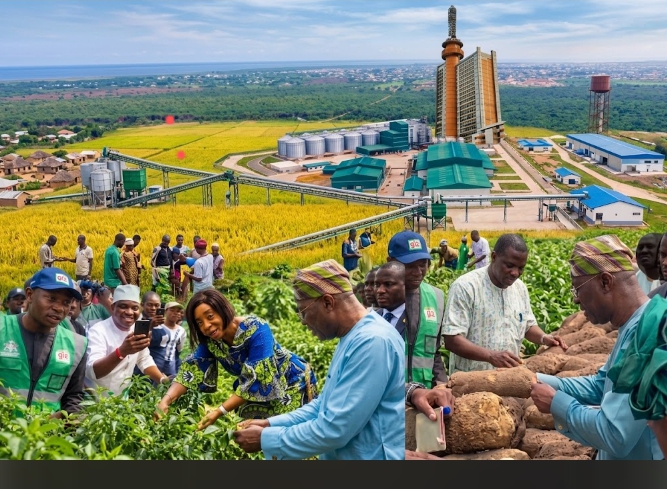
Perhaps the most visible symbol of Lagos’ agricultural ambitions is the Imota Rice Mill in Ikorodu.
The massive facility has been positioned by the state as a major component of its rice value-chain strategy, linking rice production with industrial processing and organised distribution.
The mill has a stated processing capacity of more than two million 50kg bags of rice annually, while creating direct and indirect employment opportunities and generating demand for locally produced paddy rice.
Its significance extends beyond the mill itself.
A functioning industrial rice mill requires farmers to produce paddy, transporters to move it, processors to handle it, technicians to maintain equipment, distributors to move the finished product and retailers to reach consumers.
In this sense, the rice mill represents the kind of integrated agricultural value chain Lagos is attempting to build.
The broader ambition is to demonstrate that agriculture can become a commercially attractive industry when production is connected to reliable processing and predictable markets.
Mechanisation: Bringing Technology to the Farm
Another important component of the transformation is agricultural mechanisation.
Through the Eko Agro Mechanisation Programme, Lagos has deployed the Tractor-On-The-Go platform to make mechanisation services more accessible to farmers.
The programme has reportedly supported the cultivation of more than 3,000 hectares and benefited hundreds of farmers.
For farmers, mechanisation addresses one of agriculture’s persistent problems: dependence on expensive and increasingly scarce manual labour.
But beyond reducing physical labour, mechanisation can improve the speed and scale of land preparation, planting and harvesting.
For an increasingly urbanised state where agricultural land is under pressure, improving productivity per hectare becomes especially important.
Creating a Predictable Market for Farmers
One of the biggest obstacles confronting Nigerian farmers is not necessarily production itself but the uncertainty of what happens after harvest.
A farmer may produce successfully and still suffer losses because there is no ready market, storage is inadequate or prices collapse during periods of glut.
The Produce for Lagos Programme is designed to address this problem by creating stronger links between producers and the huge Lagos consumer market.
The state’s ₦500 billion Offtake Guarantee Fund is also intended to reduce investment risks by providing greater certainty around demand and market access.
The underlying idea is straightforward: if farmers know that there is a market for their produce, they are more likely to invest in production; if financiers have greater confidence in the market, they are more likely to provide capital.
Such a model could potentially transform agriculture from a largely informal activity into a more structured commercial enterprise.
Tackling the Cost of Production
While infrastructure and market access are important, the cost of agricultural inputs remains a major challenge.
Feed alone constitutes a substantial proportion of production expenses for poultry and fish farmers.
This is why the state’s Ounje Eko Farmers’ Subsidy Programme has focused partly on reducing the cost of inputs while simultaneously attempting to protect consumers from rising food prices.
According to the Lagos State Government, the first phase benefited more than 5,000 farmers and supported the production of more than seven million eggs from 258,000 layer birds.
The government also reported distributing hundreds of tonnes of poultry and fish feed under the intervention.
The objective is to create a delicate balance: lower production costs for farmers, increased supply and, ultimately, more affordable food for consumers.
Phase II of the programme is expected to provide subsidies on selected poultry and fish feeds, while extending support to crop and pig farmers.
Whether such interventions can deliver sustainable long-term price stability will depend on their continuity, scale and ability to stimulate increased private-sector production. But the policy direction reflects a growing understanding that food security requires interventions on both the supply and demand sides of the market.
Looking Beyond Crops: Livestock and Aquaculture
Lagos’ agricultural transformation is not limited to crop production.
The state is also investing in livestock and aquaculture, sectors with enormous potential in a city where demand for animal protein continues to grow.
Among the projects is the Cattle Feedlot Project, which is targeted at supporting the production and management of more than 100,000 cattle annually.
There is also the Lagos Aquaculture Centre of Excellence (LACE), designed to strengthen the state’s fish production ecosystem.
Once completed, the facility is expected to have substantial capacities for fingerling production, fish production and aquafeed manufacturing.
For Lagos, developing aquaculture is particularly strategic. Fish is an important source of protein for millions of Nigerians, while the city’s large consumer base provides a ready market for commercially produced fish.
An efficient aquaculture ecosystem can also create opportunities for hatchery operators, feed manufacturers, fish farmers, processors, cold-chain operators, distributors and retailers.
Agriculture Meets Innovation
Perhaps one of the most interesting aspects of Lagos’ agricultural strategy is the emphasis on young people and technology.
Through the Lagos Agripreneurship Programme (LAP), the state has trained thousands of youths and women across various agricultural value chains.
Some participants have subsequently received inputs and assets to establish their own agribusinesses.
The programme reflects a recognition that the future of agriculture will require a new generation of farmers and agribusiness professionals who understand not only production but also finance, technology, marketing and value-chain development.
The state has also established the Lagos Agrinnovation Club, which seeks to connect young innovators with mentors, investors and development partners.
Its flagship innovation platform, the Lagos Agrithon, has provided grants to young entrepreneurs developing solutions to agricultural challenges.
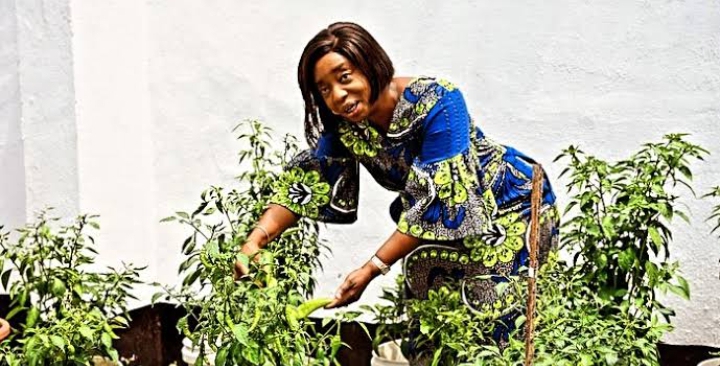
These innovations range from rooftop farming and waste-to-feed initiatives to digital platforms that connect farmers with buyers.
Such initiatives demonstrate how the constraints of urban agriculture can potentially become opportunities for innovation.
If land is scarce, technology can help farmers maximise available space. If food waste is high, innovators can explore ways of converting waste into animal feed or other useful products. If farmers struggle to find buyers, digital platforms can connect them directly to consumers and businesses.
The Human Side of Food Security
Behind the statistics and infrastructure projects are millions of people whose livelihoods depend on the success of the food system.
They include farmers cultivating crops on the outskirts of Lagos, fish farmers operating ponds, poultry farmers raising layers and broilers, traders transporting produce, processors adding value and consumers dealing with the daily reality of food prices.
For these groups, food security is not an abstract policy concept.
It is the difference between a farmer making a profit or recording a loss; between a family being able to afford protein or having to remove it from the dinner table; and between an agricultural enterprise expanding or shutting down.
The persistent challenges confronting farmers, as highlighted by policy makers including access to quality inputs, inadequate mechanisation, climate-related disruptions, rising production costs, poor rural roads, expensive transportation, weak cold-chain infrastructure and post-harvest losses. No doubt these challenges cannot be solved by government alone as it requires all stakeholders which includ banks, investors, agribusinesses, technology companies, development partners, farmers’ organisations and consumers to participate in the transformation.
The Road Ahead
Lagos’ agricultural story is therefore not simply about government-owned farms or individual agricultural projects.
It is increasingly about building an interconnected food economy.
The state’s approach combines infrastructure with market development, subsidies with private-sector participation, mechanisation with technology, and youth training with agritech innovation.
The strategy is ambitious, but it also faces significant tests.
The sustainability of subsidies, the effective utilisation of agricultural infrastructure, access to affordable finance, climate change, land availability, logistics costs and the ability to attract long-term private investment will determine how far Lagos can go.
There is also the broader question of whether agricultural production within the state can expand without compromising environmental sustainability and the competing demands of rapid urban development.
These challenges notwithstanding, Lagos is demonstrating that urbanisation does not necessarily have to mean the abandonment of agriculture.
Instead, agriculture can be redesigned for the realities of a modern city.
A New Agricultural Identity for Lagos
For years, Lagos was primarily regarded as Nigeria’s biggest consumer market.
Today, the state is attempting to add another identity to that description: a major agricultural innovation, processing and food-systems hub.
The state’s advantage is not simply its available farmland. Its greatest strength may lie in its market, infrastructure, technology ecosystem, entrepreneurial population and proximity to millions of consumers.
If these assets are successfully integrated, Lagos could become an important model for how densely populated African cities can build resilient food systems without relying entirely on distant rural production.
The real measure of success, however, will ultimately be found beyond government announcements and project inaugurations.
It will be seen in the productivity and profitability of farmers, the growth of agribusinesses, the reduction of post-harvest losses, the creation of decent jobs and, most importantly, whether ordinary Lagos residents can access safe, nutritious and affordable food.
That is the larger promise of Lagos’ agricultural transformation.
From the rice fields of Ikorodu to aquaculture facilities, food hubs, mechanised farms and technology-driven agribusinesses, the state is gradually rewriting a narrative that once seemed unlikely: that one of Africa’s most densely populated commercial cities can also become a powerful force in agricultural innovation and food security.

And if the current trajectory is sustained, Lagos may not only consume the future of Nigerian agriculture—it could help produce it.