



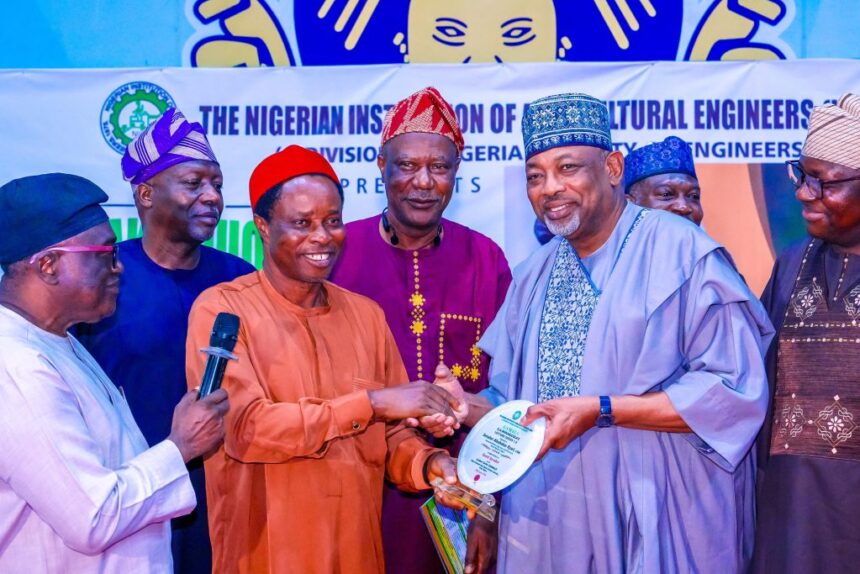
By S. David

Nigeria’s Minister of Agriculture and Food Security has declared that agricultural mechanisation is no longer a development aspiration but a strategic instrument of national economic sovereignty, pointing to the Special Agro-Industrial Processing Zone programme as the Federal Government’s clearest expression of that commitment.
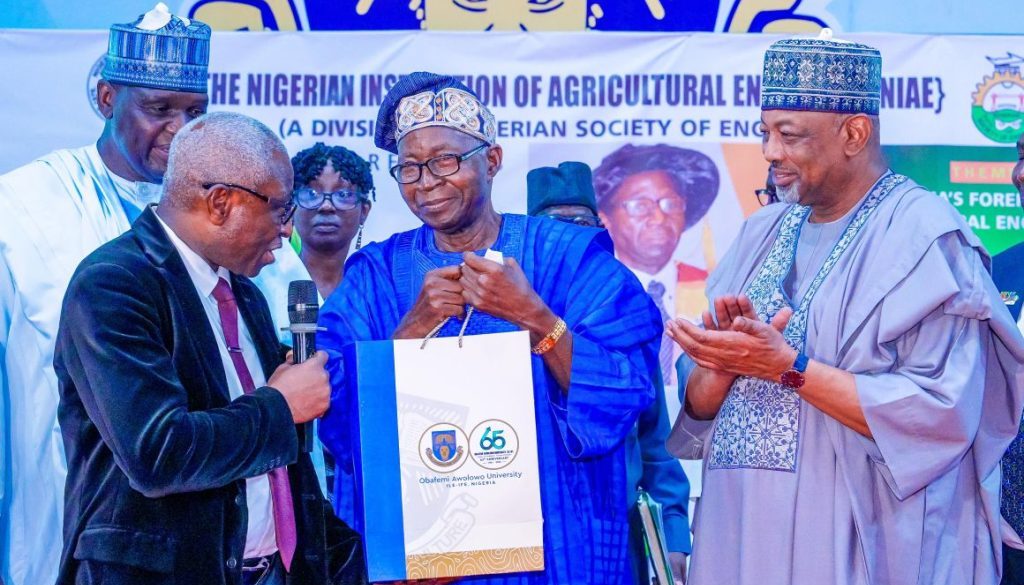
Sen. Abubakar Kyari made the declaration at Obafemi Awolowo University in Ile-Ife, Osun State, during the Prof. Gabriel Ayodele Makanjuola Lecture Series, a special event marking the 90th birthday of one of Nigeria’s most consequential agricultural engineers.

“Mechanisation is no longer optional. It is now an instrument of economic sovereignty. Agricultural engineering is no longer merely a supporting discipline. It is a strategic pillar of national transformation. But mechanisation must be scaled to the hands of the smallholder. These are the men and women who feed this nation, and they are who our strategy must reach,” the minister stated.
The lecture, themed “Honouring the Nigerian Forerunner of Agricultural Engineering at 90: Legacy, Leadership and the Future of Agricultural Transformation,” gave Sen. Kyari the platform to outline the administration’s agricultural engineering priorities under President Bola Tinubu’s Renewed Hope Agenda: expanding agricultural mechanisation, accelerating agro-industrialisation, increasing value addition and scaling digital agriculture.
At the centre of these priorities, he said, sits the SAPZ programme. The minister described it as a flagship initiative in Africa that brings agro-processing directly to farm-level communities, converting raw harvests into finished goods rather than shipping unprocessed commodities abroad.
“Nowhere is this clearer than in the Special Agro-Industrial Processing Zone programme, where all of these priorities converge. Our mission is not simply to grow more food. It is to build a resilient, tech-driven agricultural economy. A Nigeria that feeds itself on its own terms, controls its own food future, and trades with the world from a position of strength,” he said.
The occasion itself carried particular weight. Prof. Makanjuola, the nonagenarian being celebrated, built much of the intellectual and institutional foundation that gave agricultural engineering its legitimacy in Nigeria. Among his contributions are yam pounding machines that earned three British patents, a fact Sen. Kyari cited as proof that African researchers can and do produce solutions competitive with global standards.
“When a Nigerian professor’s innovation earns three British patents, it is proof that African professors can produce world-class solutions,” the minister noted. He described Prof. Makanjuola as someone who did not wait for the future of agricultural engineering to arrive before he built it, adding that the professor’s career demonstrated that technology becomes genuinely transformational only when it reduces human drudgery, improves productivity, creates wealth and restores dignity.
Prof. Makanjuola was honoured with the Nigerian National Order of Merit for his contributions to food processing, agricultural machinery and post-harvest engineering, and was among the architects of the Nigerian Institution of Agricultural Engineers.
Sen. Kyari used the occasion to challenge young Nigerian engineers to follow a similar path of building institutions rather than chasing recognition. “Do not chase the applause; chase the impact,” he told the gathering.
The SAPZ and mechanisation drive arrives on the heels of the Federal Government’s flag-off of one million improved cocoa seedlings distributed to farmers in 14 states this week. Together, these announcements suggest the Federal Ministry of Agriculture is moving into the second half of 2026 with sustained policy momentum across multiple value chains.