



By S David Prince

The Federal Government on Wednesday flagged off the distribution of one million climate-smart hybrid cocoa seedlings to farmers across Nigeria’s 14 cocoa-producing states, marking what officials described as the beginning of a strategic national effort to revive an industry that has lost ground to ageing plantations, low yields and weak investment.

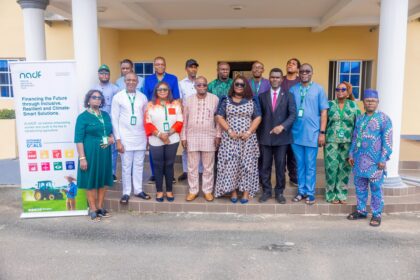
The flag-off ceremony was held at the headquarters of the Cocoa Research Institute of Nigeria in Ibadan, Oyo State, where Sen. Abubakar Kyari, Minister of Agriculture and Food Security, represented the Federal Government.
Sen. Kyari said the programme is a flagship initiative under the National Cocoa Development Plan and the Renewed Hope Agenda of President Bola Tinubu, designed to transform Nigeria’s cocoa sector from a declining commodity export into a modern, competitive industry.

“Today’s event is not merely the distribution of planting materials. It is the commencement of a strategic national intervention to restore the strength of Nigeria’s cocoa industry, improve the livelihoods of our farmers, increase export earnings, and reposition our country as a leading player in the global cocoa economy,” the minister stated.

The seedlings, developed by CRIN through a Public-Private Partnership framework, are high-yielding, early-bearing, disease-resistant varieties with built-in climate adaptation traits. They are being deployed for two purposes: the rehabilitation of existing but ageing cocoa plantations and the establishment of entirely new commercial farms. Farmers receiving the seedlings will also get extension support to help them adopt improved agronomic practices, while the government simultaneously works to expand local cocoa processing capacity to reduce raw bean exports in favour of higher-value finished products.
Dr. Marcus Olaniyi Ogunbiyi, Permanent Secretary of the Federal Ministry of Agriculture and Food Security, confirmed that the one million seedlings represent a major outcome of collaboration among government, research institutions, the private sector, development partners and farming communities. He described the programme as a long-term investment in the cocoa economy, with expected benefits including higher farm incomes, expanded employment, increased foreign exchange earnings and improved competitiveness in global markets.
The minister also disclosed a forward-looking addition to the programme. To satisfy European Union import requirements under the EU Deforestation Regulation, which is expected to significantly affect Nigerian cocoa exports in the coming years, the initiative includes traceability systems and farm mapping coordinated by the National Cocoa Management Committee and the National Task Force on EUDR. This compliance measure could prove decisive in whether Nigerian cocoa retains access to European premium markets.
Nigeria currently ranks among the world’s cocoa producers, but productivity on farmers’ fields remains far below potential. CRIN’s Tc1-Tc8 hybrid varieties, officially released in 2010, produce between 1,500 and 2,300 kg per hectare, compared to the 500 kg per hectare typical of traditional farms. The new seedlings being distributed carry similar or improved genetics, with early bearing reducing the wait for first harvest to significantly less than the five to seven years older varieties required.
Mr. Alaba Adegoke, speaking on behalf of the beneficiary farmers at the ceremony, pledged that growers would make responsible use of the improved planting materials to increase production and improve their livelihoods.
The Olubadan of Ibadanland, Oba Rasheed Ladoja, represented by the Ajiroba of Ibadan, Prof. Soji Adejumon, also gave a goodwill message at the event, affirming that Ibadan communities would support the agricultural policies of President Tinubu aimed at achieving food sovereignty and improving the livelihoods of farmers across Nigeria.
The federal government’s cocoa push joins a string of agricultural interventions already in motion this year, including the NADF’s distribution of 80,640 bags of fertiliser to North-Central farmers and the launch of a ginger value chain recovery programme in partnership with NRCRI.
Cocoa farmers in Ondo, Cross River, Ogun, Osun, Edo, Ekiti, Oyo, Kwara, Kogi, Akwa Ibom, Delta, Abia, Taraba and Adamawa states, where the 14 beneficiary states are spread, the arrival of these seedlings marks the most significant federal input support the sector has seen in years. Whether it translates into measurably higher yields and better export earnings by the time this planting cycle matures will be the true measure of the programme’s success.