
By Lanre Shodimu

As Farmlife Media concludes its tour of some agric enterprises in Rwanda, of much significance is the activities of Mr. Philemon Hatangimana, CEO and founder of Philemon farm, Mr . Philemon Hatangimana, Farmlife who shares insight and background with Farmlife Media on Mushroom cultivation.
Philemon Farm
Farmlife Media:

Could you introduce yourself and tell us about your farm and what you do?
Philemon Farm:
My name is Mr . Philemon Hatangimana , CEO and founder of Philemon Farm.
Philemon Farm is a company that works along the mushroom value chain using
Juncao technology which involves using Juncao grass to produce mushroom substrate, which we sell to other farmers in Rwanda and outside the country.
Beyond mushroom production, Juncao grass can also be used for animal feeding because it contains many nutrients. It is a hybrid of several different grasses.
We train farmers on mushroom production, and after the training, we provide them with mushroom spawn, which some people refer to as mushroom seeds, to enable them to begin production.
Farmlife Media:
How did you start your mushroom farming journey, and what were some of the challenges you encountered?
Philemon Farm:
I got my first major client about one year after I started the business. They approached me and gave me 10 million to produce mushroom seeds.
Before I started production, they told me, “Philemon, produce the mushroom seeds and we will pay you in advance.” They gave me the money, and I started production.
Unfortunately, because my skills were still limited at that time, everything I produced was lost because of bacterial contamination.
One of the major problems people face in mushroom farming is contamination, particularly from organisms such as Trichoderma. This is a common problem among mushroom farmers.
However, when you know how to prevent and control contamination, mushroom farming can be very profitable.
Farmlife Media:
How profitable is mushroom farming?
Philemon:
Mushroom farming is normally a very profitable business. You can multiply your investment within a relatively short period.
For example, if you start with 5,000, within about three months you can potentially double your investment.
But when you don’t have the necessary skills and knowledge, you can lose your capital completely. You can even lose 10,000 or whatever amount you invested.
That is why skills and knowledge are very important in mushroom farming.
Farmlife Media:
What equipment and materials are required for farmers who want to start mushroom production?
Philemon:
First, you need ginseng grass. About 80 percent of the substrate used in our mushroom farming system is Juncao grass.
You grind the Juncao grass and then mix it with materials such as rice bran and calcium carbonate.
After preparing the substrate, you introduce the mushroom spawn. Once the process is properly completed, the mushrooms will eventually grow and can be harvested.
Farmlife Media:
For someone who has never seen mushroom production before, can you explain what is inside these bags and what is happening inside them?
Philemon:
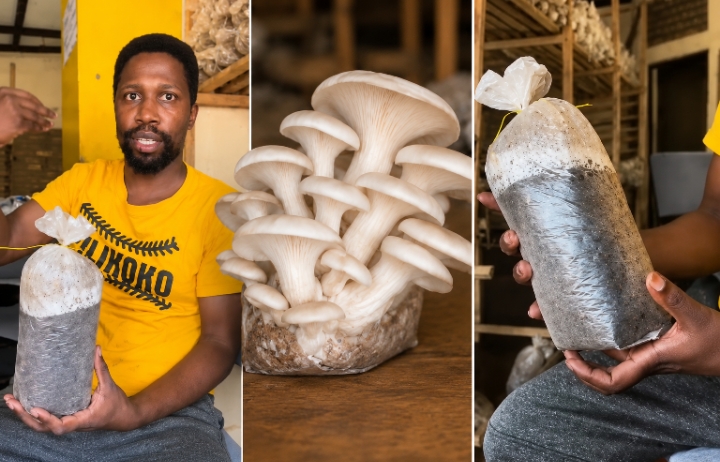
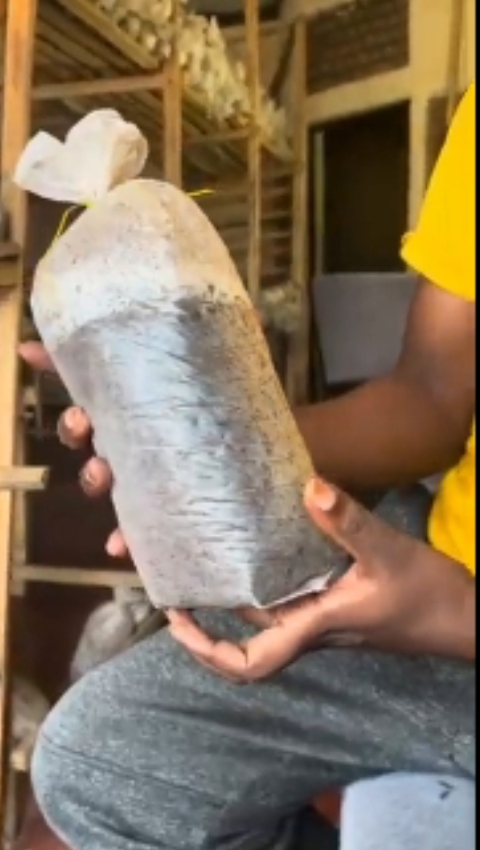
As you can see here, there is something white growing inside the bag. At this stage, it is not completely white.
This is the mycelium. The mycelium continues to spread throughout the substrate. After about one month, the substrate should become completely white.
Once it is completely colonised by the mycelium, you can move to the next stage of production.
Farmlife Media:
What happens after the substrate becomes completely white?
Philemon:
After it becomes completely white, you take it for planting or fruiting. You put it in soil in a covered environment rather than leaving it in an open space.
You then provide water. Under the right conditions, the mushrooms begin to appear and you can start harvesting.
Farmlife Media:
So, how long does the initial process take before the farmer can move to the planting stage?
Philemon:
It takes about one month. After one month, when the substrate has been fully colonised, you can move it to the next stage.
Farmlife Media:
Are these what you would call the mushroom seeds?
Philemon:
Yes, these are what many people refer to as the mushroom seeds. However, I can also show you the laboratory where we produce the spawn.
Farmlife Media:
Can you explain what happens in the laboratory and how mushroom spawn is produced?
Philemon:
This is where the science starts.
To produce mushroom spawn, we start with a test tube. Before producing the culture in the test tube, we prepare what is called PDA, which is a growth medium used for cultivating the mushroom tissue.
We prepare the liquid medium and then introduce a small piece of mushroom tissue into it. That becomes the starting point for producing the mushroom culture.
This is a very important stage because in Africa, it is still difficult to find many people who have the capacity to produce mushroom spawn.
Mushroom spawn is different from what farmers commonly refer to as mushroom seed.
Once you have the initial culture, you can multiply it several times by transferring it into other prepared substrates. Through this multiplication process, you eventually reach the stage where you have mushroom spawn that can be supplied to farmers for production.
After obtaining the appropriate spawn, farmers can begin the production process and eventually harvest mushrooms.
Farmlife Media:
Why do you think it is important for people to understand the science behind mushroom farming?
Philemon:
What I want to show people is that if they are able to learn more about the science of mushroom farming, they can do it themselves.
We are able to help people online, and people who are in Rwanda can also come here to learn directly.
The knowledge is very important because mushroom farming requires proper skills, especially when it comes to producing spawn and preventing contamination.
Farmlife Media:
Where did you acquire the advanced knowledge and skills you are using today?
Philemon:
I studied agriculture at the University of Rwanda, and after that, I went to China to further my studies and advance my knowledge of Juncao technology.
What we are doing here is based on that Juncao technology.
Farmlife Media:
What is this equipment, and what is it used for?
Philemon:
This is an autoclave. It is used to sterilise materials and eliminate bacteria and other contaminants.
You heat the materials inside the autoclave, and after the sterilisation process, they can be used for mushroom production.