



By: Simeon Shodimu

The State of Israel has reaffirmed its commitment to strengthening bilateral relations with Nigeria through expanded cooperation in agriculture, innovation, healthcare, security, education and entrepreneurship.
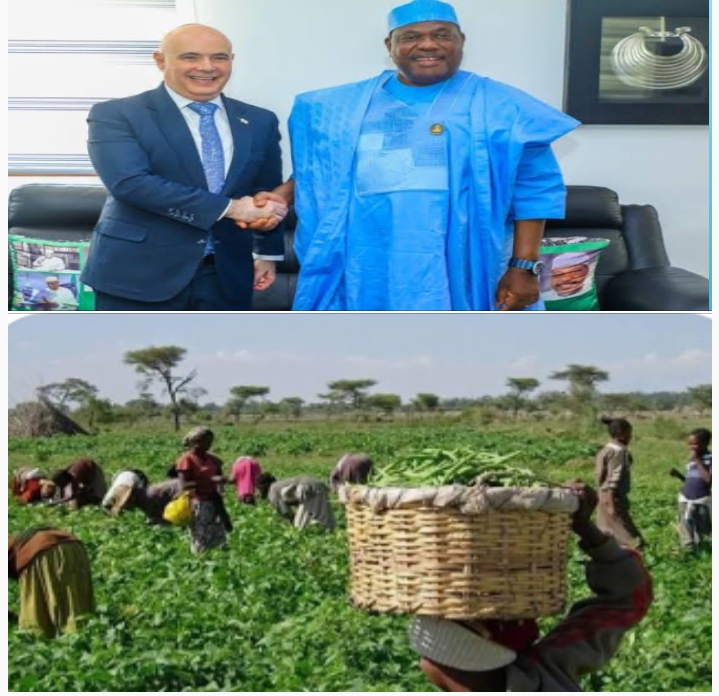
Speaking during Israel’s 78th Independence Anniversary celebration in Abuja on Monday, the Israeli Ambassador to Nigeria, Michael Freeman, disclosed that Israeli agricultural technologies and seedlings are already being used by Nigerian farmers across the country, contributing to improved productivity and food security.
According to Freeman, Israeli companies have established a presence in Nigeria and are working closely with local farmers to enhance agricultural output through modern farming techniques.

He explained that while the technology and seedlings originate from Israel, the cultivation takes place on Nigerian soil and is carried out by Nigerian farmers, creating a partnership that combines Israeli innovation with Nigerian enterprise.
To demonstrate the impact of the collaboration, guests at the anniversary event received boxes of vegetables grown from Israeli seedlings using Israeli technology.
“These vegetables were grown from Israeli seedlings using Israeli technology but grown by Nigerian farmers on Nigerian soil,” Freeman said. “They represent possibility. Imagine that success multiplied across Nigeria—higher yields, stronger rural communities, greater food security and millions of lives improved.”
The ambassador described the agricultural partnership as part of a broader framework of cooperation aimed at fostering sustainable development and economic growth in both countries.
Beyond agriculture, Freeman announced new initiatives designed to deepen ties between Nigeria and Israel. These include a fifth cohort of Israel’s entrepreneurship development programme scheduled for 2027 and the donation of three fully equipped ambulances to Nigeria.
The ambulances, he noted, are already on their way to the country and are expected to strengthen emergency healthcare services and save lives.
“These ambulances are more than vehicles,” he said. “They are symbols of partnership and examples of what can be achieved when nations choose cooperation over rhetoric.”
Freeman stressed that Israel’s engagement with Nigeria is not driven by charity but by a belief in mutual prosperity and shared progress.
“The future of Israeli-Nigerian relations will be defined by entrepreneurs who create businesses, farmers who increase production, healthcare professionals who save lives and young people who refuse to be limited by circumstances,” he said.
Reflecting on Israel’s development journey, the envoy recounted how the country transformed itself from a resource-constrained nation into a global centre for technology and innovation.
He noted that despite its limited natural resources and difficult environmental conditions, Israel succeeded in pioneering advancements such as drip irrigation, precision agriculture, desalination technology, medical innovations and cybersecurity solutions.
“Israel became a technological powerhouse not because our challenges were small, but because they were enormous,” Freeman stated. “We learned that every problem contains within it a seed of opportunity.”
The ambassador expressed confidence that Nigeria possesses similar potential, citing its large youth population, entrepreneurial spirit and vast agricultural resources.
He also highlighted the success of the Israel-supported IFARE programme, which has continued to provide mentorship, training and business development support to young Nigerian entrepreneurs.
In her remarks, the Minister of Art, Culture and Tourism, Hannatu Musawa, congratulated the government and people of Israel on the country’s 78th Independence Anniversary and reaffirmed Nigeria’s commitment to strengthening bilateral relations.
Musawa described Nigeria and Israel as long-standing partners united by common aspirations for economic transformation, innovation and cultural exchange.
“While our nations are separated by geography, we are united by a rich tapestry of cultural diversity and interdependent energy,” she said.
The minister emphasized Nigeria’s interest in expanding collaboration with Israel in key sectors, including culture, tourism, agriculture, innovation and the creative economy.
She further noted that cultural diplomacy remains a powerful instrument for fostering mutual understanding, educational exchange and economic growth among nations.
The growing partnership between Nigeria and Israel reflects a shared commitment to leveraging technology, innovation and human capital to address development challenges and unlock new opportunities for prosperity. As both countries seek to deepen cooperation, agriculture appears set to remain one of the most promising areas of collaboration, with the potential to enhance food security, create jobs and improve livelihoods across Nigeria.