



By Simeon Shodimu

As Nigeria grapples with rising food import bills and the growing urgency to secure its agricultural future, stakeholders across government, development agencies, and the private sector are rallying around a renewed strategy—one that prioritises innovation, partnerships, and scale. The 40th anniversary of the Sasakawa Africa Association has become more than a celebration; it is a pivotal moment to reassess progress and chart a new course for agricultural transformation.
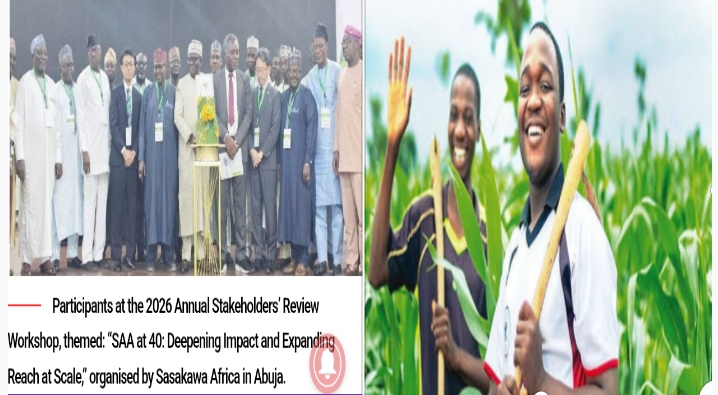
Policymakers, development partners, diplomats, and agricultural experts recently converged to mark a rare milestone in Africa’s development landscape—four decades of sustained intervention in agriculture by the Sasakawa Africa Association (SAA).
Celebrating 40 years globally and 34 years of operations in Nigeria, the organisation used its 2026 Annual Stakeholders’ Review Workshop to not only reflect on its legacy but also signal a renewed commitment to scaling impact in a sector critical to the nation’s economic stability.
Held under the theme “SAA at 40: Deepening Impact and Expanding Reach at Scale,” the gathering underscored the urgency of transforming Nigeria’s agricultural sector amid mounting pressures from climate change, rapid population growth, and a widening gap between food production and demand.
A legacy shaped by adaptation
In his opening remarks, SAA Nigeria Country Director, Dr. Godwin Atser, described the anniversary as both a celebration of impact and a call to action. He noted that SAA has continually evolved its focus to reflect changing realities in agriculture.
From strengthening food system resilience in 2023 to advancing decarbonisation in 2024 and promoting digital agricultural extension in 2025, the organisation has remained aligned with global and local priorities.
These interventions have attracted strong funding support from institutions such as the African Development Bank and the Gates Foundation, enabling the rollout of innovative programmes across Nigeria.
Despite these gains, Atser highlighted a persistent challenge: Nigeria’s annual food import bill, estimated at $10 billion, driven by deficits in staples such as rice, wheat, and fish.
“Our production capacity still lags behind demand,” he said, stressing the need to scale extension services and deploy appropriate technologies directly to farmers.
He also pointed to the alarming ratio of one extension agent to up to 10,000 farmers, reinforcing the urgency of digital solutions to bridge the knowledge gap.
Government reaffirms commitment
Representing the Minister of State for Agriculture and Food Security, Senator Aliyu Sabi Abdullahi, Permanent Secretary Dr. Marcus Ogunbiyi described SAA’s journey as a testament to resilience and innovation.
He reiterated that agriculture remains central to Nigeria’s economic diversification agenda under President Bola Ahmed Tinubu’s Renewed Hope programme.
According to him, recent initiatives such as the Renewed Hope for Food Security and Sovereignty Programme are already yielding results through improved farm security, expanded access to inputs, and strengthened fertiliser distribution systems.
He also highlighted progress under the Nigerian Farmers Soil Health Scheme, a multi-partner initiative supported by institutions including the World Bank, GIZ, OCP Africa, AGRA, and SAA.
Key milestones include the introduction of Soil Health Cards, a national soil information system, and Nigeria’s integration into the ECOWAS Regional Fertiliser Hub. Modern soil laboratories have also been deployed across 12 states, while a national policy committee on soil and land management has been inaugurated.
Despite these advances, Ogunbiyi acknowledged ongoing challenges such as climate change, soil degradation, post-harvest losses, and limited access to finance.
Smallholders at the centre
Delivering the keynote address, Japan’s Ambassador to Nigeria, Shuichi Suzuki, emphasised the pivotal role of smallholder farmers, who form the backbone of Nigeria’s agricultural system.
With the sector employing about 34 percent of the workforce and contributing roughly a quarter of GDP, he noted that unlocking its full potential requires targeted investments in mechanisation, market access, and post-harvest management.
Suzuki commended SAA’s contributions over the years, particularly in equipping farmers with modern techniques and improving rural livelihoods through technology transfer.
Driving innovation across the value chain
Providing further insight into technical interventions, Ishigame Keiji, Chief Representative of the Japan International Cooperation Agency (JICA), outlined a comprehensive strategy that goes beyond production to encompass the entire agricultural value chain.
Central to this is the development of robust seed systems, including support for high-quality rice seed production through grants and technical cooperation.
However, Keiji stressed that productivity gains alone are insufficient without access to markets. To address this, JICA has implemented the Market-Oriented Agriculture Extension Project (SHEP), encouraging farmers to adopt a business-oriented approach to production.
The agency is also advancing digital credit systems that assess farmers’ creditworthiness using transaction data, thereby expanding access to finance for smallholders traditionally excluded from formal banking systems.
Looking ahead, JICA is exploring a two-step agricultural finance model aimed at providing long-term funding through public financial institutions to farmers and agribusinesses.
Mechanisation as a catalyst
Mechanisation emerged as a key theme at the workshop, not merely as access to machinery but as a strategic driver of productivity, efficiency, and resilience.
Through the Africa Field Innovation Center for Agricultural Technology (AFICAT), JICA has introduced and adapted Japanese agricultural technologies suited to Nigeria’s conditions.
Since its launch in 2022, AFICAT has facilitated field assessments, technical workshops, and collaborations among farmers, researchers, and private sector stakeholders.
The initiative serves as a bridge connecting innovation with practical application, ensuring that mechanisation efforts are sustainable and market-driven.
Partnerships remain critical
Across all discussions, stakeholders emphasised that collaboration is essential to achieving meaningful transformation in agriculture.
Dr. Atser acknowledged the contributions of long-standing partners, including the Nippon Foundation and other multilateral and philanthropic organisations, whose support has sustained SAA’s work over the decades.
Government representatives also called for deeper collaboration to address systemic challenges and build a resilient agricultural sector capable of feeding Nigeria’s growing population.
The road ahead
As the workshop concluded, stakeholders agreed that while progress has been made, significant work remains.
Nigeria’s agricultural sector stands at a critical juncture—rich in potential but constrained by structural challenges.
The path forward, participants noted, lies in scaling proven solutions: expanding digital extension services, strengthening soil health systems, improving access to finance, and accelerating mechanisation.
Equally vital is empowering farmers as entrepreneurs capable of navigating markets and adopting innovation.
For SAA, its 40th anniversary marks not just a reflection on past achievements but a renewed commitment to shaping the future.
With sustained partnerships, policy support, and a focus on scalable innovation, stakeholders believe Nigeria can unlock its agricultural potential—transforming the sector into a cornerstone of food security and sustainable economic growth.