


By Simeon Shodimu

In recent years, Nigeria’s agricultural sector has seen a significant surge in investment, owing to efforts by the government to improve stakes in the sector.
Investments according to data rose to 224 percent in one year despite security challenges in the country which has continued to bedeviled the country for more than a decade.
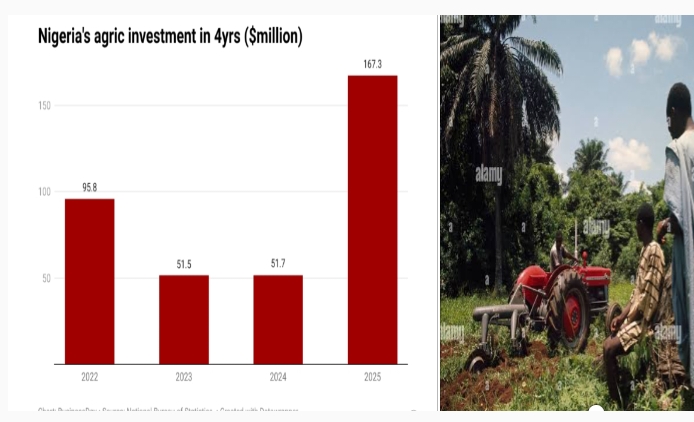
While the country has continued to experience spike in the prices of food in the country, owing to insecurity and other factors include hike in fuel, data from the National Bureau of Statistics (NBS) capital importation report showed that foreign direct investment (FDI) in the agric sector hit $167.3 million in 2025, up 224 percent from $51.7 million in 2024.

On a quarter-on-quarter basis, investment into the sector surged 216 percent to $51.2 million in the fourth quarter of 2025 from $16.2 million in the corresponding period of 2024.
Investments in the agricultural sector prior 2022, investments have consistently been growing at an annual average of 82 percent since 2016, but then reversed in 2022 and continued to decline through 2024, before rebounding in 2025, according to BusinessDay’ analysis.
The renewed surge in investment in the sector can attributed to favourable government policies, including importation waivers. the sector according to experts can be attributed the
“The economic reforms that restored investors’ confidence and the government’s continuous support to the sector are major drivers of these investments,” said AfricanFarmer Mogaji, chief executive officer, Agbado Value-Chain Ltd
“Also, the country’s growing population always makes the industry attractive for investors, as people must eat. This increased the number of investors, domestically and foreign, who invested in the industry,” Mogaji said.
Nigeria’s agricultural industry experienced several shocks in 2025 that disrupted the food systems and hampered productivity.
High insecurity has significantly impacted farming activities in the country, with the situation intensifying in 2025, forcing many farmers to abandon their farmlands.
Prices of key inputs such as seeds, herbicides, pesticides, fertilisers, and agro machinery tripled in 2025 due to the naira devaluation and spikes in headline inflation.
The surge in production costs, combined with low food prices, eroded farmers’ ability to recover investments made during the 2025 season, leaving many with huge financial losses.
Similarly, the increasing impact of climate change on communities disrupted farming activities during the year. While no country is immune to the impacts of climate change, Nigeria is among the countries that are most vulnerable and least able to cope with the impacts of a changing climate.
The fishing industry, which is one of the sub-sectors of the agricultural industry, attracted a $5.1 million investment in 2025 from zero investments in 2024.
The sector grew by 2.92 percent in 2025 as its performance was significantly impacted by increased youth participation and rising investment in mechanised farming.