

By: Kemi Akinseye

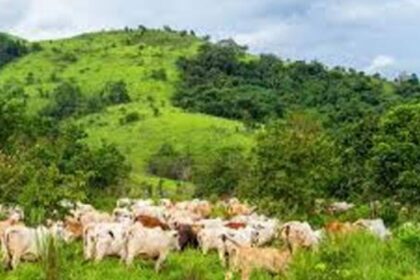
The Federal Government has unveiled an ambitious roadmap aimed at expanding Nigeria’s livestock economy from an estimated $32 billion to $74 billion within the next decade, as part of broader efforts to drive food security, industrial growth and export development.

The Minister of Livestock Development, Idi Mukhtar Maiha, disclosed this in Abeokuta, Ogun State, during the 28th Global Convention and 27th Annual Lecture of the Federal University of Agriculture, Abeokuta Alumni Association.
Maiha explained that the strategy is anchored on the National Livestock Transformation Plan and supported by new financing and infrastructure initiatives designed to modernise the sector and attract investment.
A major highlight of the plan is a $300 million support package from the African Development Bank, which will focus on feed production, animal health systems, breed improvement and rural infrastructure development.
The minister, represented by his Senior Special Adviser on Knowledge Management and Communication, Richard-Mark Mbaram, noted that the initiative aligns with Nigeria’s participation in the Special Agro-Industrial Processing Zones Programme, which has already attracted over $530 million in investment to Ogun State.
According to him, the livestock sector is being repositioned from a subsistence-based activity to a structured and productivity-driven business ecosystem capable of generating jobs, improving nutrition and boosting exports.
Maiha described the creation of the Federal Ministry of Livestock Development by President Bola Ahmed Tinubu as a historic policy shift aimed at unlocking value across the meat, dairy, poultry and allied agricultural value chains.
He also highlighted the role of livestock development in improving child nutrition through an expanded school feeding programme supported by a $20 million grant from development partners. He said the programme is expected to increase protein intake among schoolchildren while creating stable markets for local livestock producers.
Delivering a lecture titled “A Megatrend Approach to Creating Long-Term Business and Investment in an Evolving Economy,” industrialist Goke Adeyemi urged policymakers and investors to focus on fixing structural inefficiencies in agriculture, particularly post-harvest losses.

Adeyemi noted that nearly 50 per cent of Nigeria’s agricultural produce is lost due to inadequate storage, logistics and processing infrastructure, stressing that investments in cold-chain systems, agro-processing and market linkages remain critical to transforming Nigeria into a reliable global agri-food exporter.
In his remarks, the Vice-Chancellor of Federal University of Agriculture, Abeokuta, Babatunde Kehinde, described the alumni association as a strategic partner in institutional and national development.
He cited alumni-led initiatives such as a 2,000-hectare farm hub, transport schemes and student support programmes as examples of how diaspora engagement can contribute to economic and educational advancement.
The President of the alumni association, Bolaji Gbadamosi, said the body’s chapters across the United States, the United Kingdom and Canada have continued to support scholarships, food intervention programmes and academic mentoring initiatives.
Highlights of the convention included the launch of the maiden Alumni Compendium and discussions on a proposed partnership between the alumni association and the Federal Ministry of Livestock Development to transform the university’s farm hub into a national innovation and demonstration centre in support of Nigeria’s food security agenda.