



By Lanre Shodimu

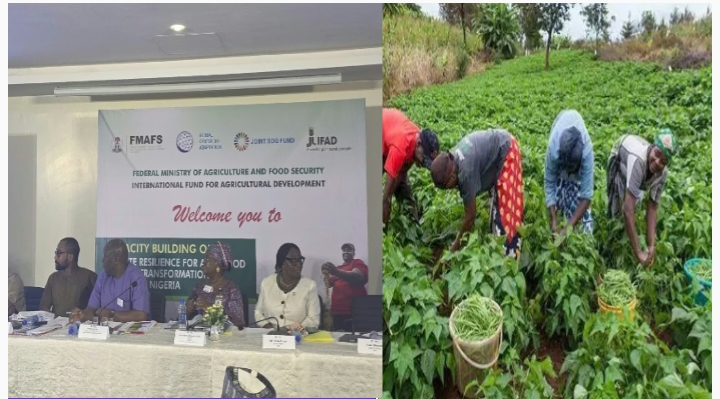
“Stakeholders and development partners during the climate finance mobilisation workshop in Abuja focused on strengthening climate-resilient agriculture and unlocking global investment for northern Nigeria’s agri-food systems”.
As climate change continues to threaten food production across northern Nigeria through droughts, floods and land degradation, the Federal Government and international development partners are intensifying efforts to position the country as a major destination for global climate finance. With growing interest from multilateral funds and private investors, stakeholders say Nigeria’s ability to attract large-scale climate investments could determine the future of food security, rural livelihoods and agricultural resilience in the region.
Nigeria is positioning its northern agricultural corridor as an investment-ready destination for global climate finance, as government agencies and international development partners step up efforts to mobilise funding for climate-resilient agriculture under the Value Chain Programme in Northern Nigeria (VCN).
The renewed push formed the centrepiece of discussions at a high-level workshop on climate risk, adaptation and climate finance mobilisation held in Abuja, where stakeholders outlined strategies for attracting financing from multilateral climate funds and private sector investors.

At the heart of the discussions was the growing concern over the devastating impact of climate change on agriculture, particularly in northern Nigeria where recurring droughts, floods, desertification and land degradation continue to threaten food production and rural livelihoods.
Country Director of the International Fund for Agricultural Development (IFAD) in Nigeria, Dede Ekoue, said the VCN programme has now moved from planning to implementation following the approval of a joint roadmap and the release of its first disbursement.
She explained that while initial funding would support early climate-resilient agricultural interventions, Nigeria must attract larger pools of climate finance to scale impact across the region.
According to Ekoue, securing financing from institutions such as the Green Climate Fund and environmental, social and governance (ESG) investors would depend largely on Nigeria’s ability to demonstrate measurable and data-driven outcomes.
“Climate finance is key to sustain and scale up the impact of the initial investment,” she said.
Ekoue noted that Climate Risk and Vulnerability Assessments (CRAVA) are already being integrated into the programme’s design to reduce investment risks and guide adaptation strategies.
She explained that the assessments help identify vulnerable landscapes and determine interventions suited to specific ecological conditions.
Among the proposed interventions are solar-powered irrigation systems for arid communities and flood-tolerant seed varieties for flood-prone areas, measures designed to protect farmers from increasingly severe climate shocks.
According to her, grounding investments in scientific climate analysis would ensure that resources are directed toward interventions capable of delivering measurable resilience outcomes.
The Federal Government also reaffirmed its commitment to strengthening institutional readiness for climate finance mobilisation.
Director of the Federal Department of Development Partners Projects at the Federal Ministry of Agriculture and Food Security, Adebola Iluromi, said the workshop was organised to equip stakeholders with the capacity to develop bankable investment plans aligned with both national and global climate frameworks.

She stressed that attracting climate finance goes beyond accessing funds and requires stronger institutions, improved investment planning and effective monitoring systems capable of demonstrating impact.
According to Iluromi, Nigeria’s agricultural sector is already experiencing severe climate-related disruptions, including prolonged droughts, flooding, excessive heat and environmental degradation.
She warned that these challenges pose serious threats to food security and rural economies, especially across northern Nigeria where millions depend on agriculture for survival.
She further stressed the need for coordinated collaboration among federal and state governments, development partners and the private sector to drive inclusive and climate-resilient agricultural growth.
A key technical partner in the programme, the Global Center on Adaptation (GCA), highlighted the broader financing gap affecting smallholder farmers across Africa.
Global Programme Lead for Food Security and Rural Wellbeing at GCA, Olu Ajayi, said smallholder farmers remain highly vulnerable to climate shocks due to limited access to finance and adaptation solutions.
He noted that agriculture remains central to economic growth and poverty reduction across Africa, making climate resilience an urgent priority for governments and investors alike.
Ajayi explained that GCA is collaborating with institutions such as the African Development Bank, World Bank, Islamic Development Bank and IFAD to integrate climate adaptation measures into large-scale agricultural investments.
In Nigeria, he said, the organisation is supporting the VCN programme through climate vulnerability assessments, adaptation financing strategies and digital agriculture initiatives aimed at strengthening farmer resilience.
He added that GCA has supported the development of more than 30 climate-resilient agricultural investment projects across Africa and Asia over the past five years, covering 26 African countries.
Participants at the workshop emphasised that Nigeria must also attract private sector capital by demonstrating that its agricultural value chains are profitable, sustainable and climate-resilient.
According to stakeholders, global investors are increasingly focusing on “investment-ready landscapes” where climate risks are clearly identified and mitigation strategies are already in place.
The VCN programme, which spans nine northern states, is expected to serve as a model for integrating climate adaptation into agricultural value chains while boosting productivity, food security and rural incomes.
Stakeholders also underscored the importance of digital technologies, including climate advisory services and data-driven decision-making tools, in strengthening support for farmers and improving agricultural planning.
As climate threats intensify across the Sahel region, participants expressed optimism that Nigeria’s combination of policy reforms, technical capacity and early investment results could significantly improve the country’s chances of attracting large-scale climate finance.
Beyond Nigeria, stakeholders believe the success of the initiative could provide a practical blueprint for climate-resilient agriculture across West and Central Africa.