



Flip Farm Resorts Rides on Research, Launches Crawfish Training to Boost Nigeria’s Aquaculture Economy

By Simeon Shodimu
As Nigeria grapples with rising food import bills and protein shortages, fresh insights from academia and private sector innovation are converging to unlock the vast potential of aquaculture. With fish importation draining over $1 billion annually, stakeholders are now turning to sustainable fish farming and emerging niches like crawfish production as viable pathways to economic growth, food security, and job creation.

Flip Farm Resorts has aligned with emerging academic insights on Nigeria’s fisheries potential, leveraging university-backed research which indicates that the country could save over $1 billion annually by strengthening local fish production. As part of efforts to drive this transformation, the resort is set to commence structured training in crawfish farming—an emerging frontier in Nigeria’s aquaculture value chain.
This development follows recent findings by Professor Dominic Odedeyi, a Professor of Fisheries and Aquaculture, who stated that Nigeria can significantly reduce its dependence on fish importation while boosting the economy if its abundant fisheries resources are effectively harnessed.
Delivering the 58th Inaugural Lecture at Adekunle Ajasin University, Akungba Akoko, Ondo State, titled “From Creation to Cultivation: Enhancing Fish Biology for Humanity,” Odedeyi emphasised sustainable fisheries as a key driver of economic growth, employment, and improved livelihoods.
According to him, Nigeria, endowed with extensive freshwater and marine resources, has strong potential to become a major player in global aquaculture. However, challenges such as overfishing, pollution, poor regulatory enforcement, and limited research on indigenous species continue to hinder the sector’s growth.
He noted that Nigeria produces about 1.2 million metric tonnes of fish annually, with most consumed locally, yet the supply gap persists—contributing to rising food insecurity and increased import dependence.
Odedeyi called for greater investment in research, particularly in indigenous fish species with aquaculture potential, alongside improved extension services and stronger environmental regulations to protect aquatic ecosystems.
Crawfish Farming: A New Frontier
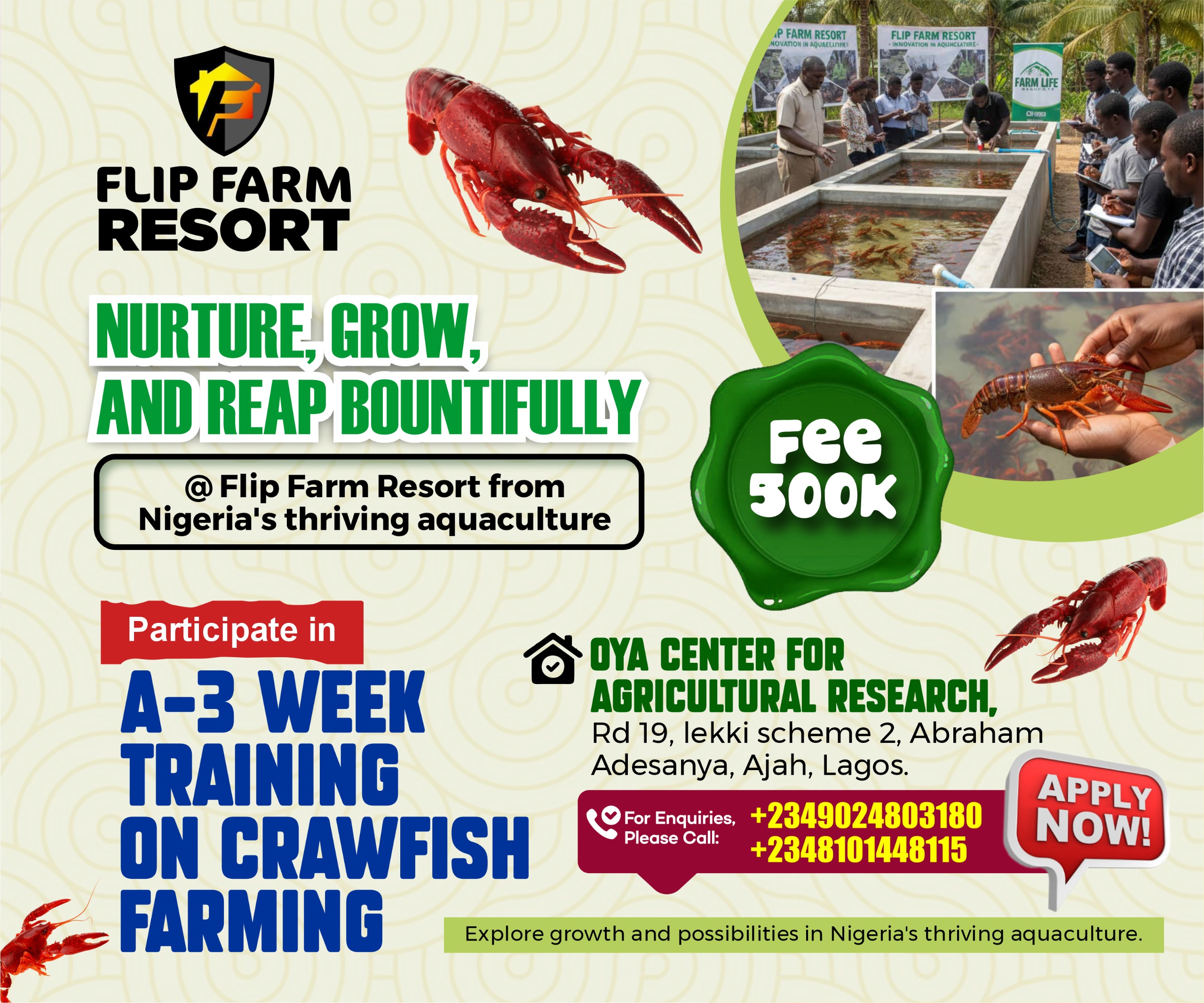
In response to these gaps, Flip Farm Resorts is stepping in to bridge the knowledge divide through practical, hands-on training in crawfish farming. Unlike conventional fish farming, crawfish production remains largely untapped in Nigeria despite strong market demand.
Industry observers note that while interest in crawfish farming is growing, many aspiring farmers lack the technical expertise required for success—often resulting in poor yields and high mortality rates.
Flip Farm Resorts aims to change this narrative by offering structured training programmes that combine theory with real-time farm experience. The initiative is designed to equip participants with essential skills in farm setup, broodstock management, feeding, water quality control, and market access.
Building Capacity, Creating Opportunities
Under the leadership of Jide Akinseye, the resort is positioning itself as a hub for aquaculture innovation, training, and mentorship. Its crawfish programme is tailored not only to educate but also to support participants in launching viable agribusiness ventures.
The training model includes live demonstrations, practical sessions, and post-training support—ensuring that participants transition from learning to earning.
As Nigeria intensifies efforts toward food security and import substitution, stakeholders believe that alternative aquaculture systems like crawfish farming could open up new income streams, particularly for youths and agripreneurs.
Toward a Sustainable Aquaculture Future
With plans to expand training programmes, build partnerships, and develop a nationwide network of crawfish farmers, Flip Farm Resorts is contributing to the gradual reshaping of Nigeria’s aquaculture landscape.
Experts maintain that the future of fish production in the country lies not only in scaling existing systems but also in diversifying into high-value species and strengthening knowledge-driven practices.
As the sector evolves, initiatives that combine research, training, and enterprise development—such as that of Flip Farm Resorts—may prove critical in unlocking Nigeria’s aquaculture potential and reducing its reliance on imported seafood.