





Falling Prices, Rising Costs Push Nigerian Rice Farmers to Cut Back as Imports Surge

By Simeon Shodimu
Nigeria’s rice industry is facing renewed strain as a sharp fall in paddy prices, rising production costs, and a resurgence of cheaper imports force farmers to scale back cultivation. From Kebbi to Jigawa, declining profitability and a struggling milling sector are reshaping planting decisions, raising fresh concerns about the country’s food security ambitions.
Nigerian rice farmers are cutting back on plans for the 2026 planting season as falling paddy prices, rising production costs, and a struggling milling industry erode profitability across the value chain.
The price of paddy has plunged by 51 percent to N350,800 per ton, down from a peak of N720,000 in 2025. The decline, driven by a surge in cheaper imports and persistent smuggling, has left many farmers unable to break even.
This downturn poses a significant challenge to President Bola Tinubu’s food security agenda in Africa’s most populous nation, where rice remains the most widely consumed staple.
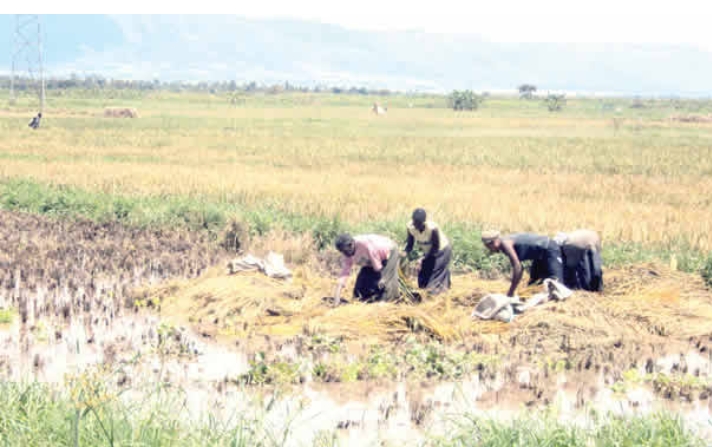
In Kebbi State, Nigeria’s leading rice-producing hub, fewer than 30 percent of the over 500,000 registered rice farmers participated in the just-concluded 2026 dry season, according to Muhammed Augie, former chairman of the Rice Farmers Association of Nigeria (Kebbi chapter).
“They are already pulling back ahead of the wet season,” Augie said, referring to the small fraction of farmers who cultivated during the dry season.
The situation is particularly concerning given Kebbi’s dominant role in national output, accounting for an estimated 70 percent of Nigeria’s rice production. Augie noted that many farmers are still holding unsold paddy due to weak demand, largely caused by the near collapse of the local milling industry.
As a result, farmers are shifting to alternative crops such as sorghum, soybean, and sesame, which currently offer better returns.
A March 2026 report by the United States Department of Agriculture (USDA) projects Nigeria’s rice cultivation area will decline by seven percent to 4.2 million hectares in the 2026/2027 season, down from 4.5 million hectares in the previous cycle. The report cites low prices, high input costs, and worsening insecurity in key producing regions as major constraints.
“Low rice prices continue to discourage farmers from expanding production, even as consumption is expected to rise,” the USDA noted.
For farmers like Musa Idris in Jigawa State, the impact is already stark. Previously cultivating between 40 and 50 hectares, he has now scaled down to just five hectares.
“It’s becoming too expensive to grow rice locally and still sell at a profit,” he said.
Idris explained that he once operated at scale due to steady demand from local mills. However, both mills he supplied have shut down since 2024, forcing him to drastically reduce production.
Local Rice Struggles to Compete
Despite previous gains in productivity and expanded milling capacity, Nigeria’s local rice industry remains uncompetitive compared to imports, largely due to high production costs.
Major exporters like India and Thailand benefit from economies of scale, efficient systems, and strong government support, allowing them to produce at significantly lower costs. In contrast, Nigerian producers face erratic operating conditions and high overheads.
Peter Dama, national chairman of the Rice Millers Association of Nigeria (RIMAN), said local millers are burdened with providing their own infrastructure.
“We generate our own power, water, roads, and even security just to operate. Meanwhile, in countries like India, Thailand, and Vietnam, these are provided by government at little or no cost,” he said.
He warned that more than 60 rice mills have shut down due to their inability to compete with cheaper imported varieties.
Imports and Smuggling Resurge
The industry is further under pressure from a renewed wave of imports and smuggling, threatening to undo years of investment in domestic production.
Nigeria imported 60,735 metric tons of rice from Thailand in the first five months of 2025, according to the Thai Rice Exporters Association — the highest level since 2016, when the country began its rice self-sufficiency drive.
A survey of major rice markets in Lagos shows foreign parboiled rice once again dominating retail shelves, reflecting a shift in supply dynamics.
Analysts attribute the resurgence to lower prices of imported rice, consumer preference for foreign varieties due to perceived quality differences, porous borders, and policy measures such as the 150-day duty-free window for essential food imports introduced last year.
Nigeria also continues to face a significant supply gap. While demand is estimated at about 7 million metric tons of milled rice annually, domestic production stands at roughly 4.6 million metric tons.
Recent fiscal adjustments have further lowered import duties — bulk rice tariffs have been reduced to 47.5 percent from 70 percent, while duties on broken rice now stand at 30 percent.
Development experts warn that these measures could accelerate the influx of cheaper imports, deepening the crisis for local producers.
“Rice importation will likely increase further under the current policy environment,” Dama cautioned.