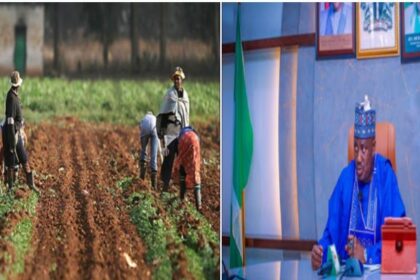





FG assigns coordinators to 13 states to boost rice farming.

By Jide Akinseye
Federal Government of Nigeria as part of efforts to boost rice production in Nigeria has deployed state coordinators across 13 pilot states to strengthen intelligence gathering on agricultural production patterns, following an earlier mass abandonment of rice cultivation by over 3,500 farmers who recorded cumulative losses estimated at N93bn.
This was as the Presidential Food Systems Coordinating Unit, in collaboration with the Federal Ministry of Agriculture and Food Security, convened an orientation and training session for State Focal Persons at the headquarters of the National Agricultural Extension and Research Liaison Services in Zaria, Kaduna State.

Details of the programme recently made available to PUNCH states that the engagement, which marked Cycle 3 of the National Agribusiness Policy Mechanism, focused on strengthening a shared understanding of the minor season.
The Presidential Food Systems Coordinating Unit operates under the Presidency and is responsible for coordinating food security policies and programmes across multiple government agencies and stakeholders.
The NAPM expressed concern that the minor season is an often under-analysed production window within the country’s agricultural calendar.
PUNCH gathered that the minor season, typically spanning shorter planting cycles between major rainy seasons, has historically received less policy attention despite its strategic importance for food security and crop diversification, it argued.
Assistant Director, Research, Planning, Monitoring and Evaluation at NAERLS, Dr Tunji Iyiola-Tunji, who spoke at the training, emphasised that credible field-level data had enabled government to detect the rice cultivation crisis before the 2026 dry season planting.
“When NAPM findings suggested that farmers were not prioritising rice planting in the 2026 dry season, we were sure of this information because the farmers themselves told us. It reflects what producers themselves are signaling.
“Before national decisions are made, government must first understand how farmers are utilising seasonal windows and what producers themselves are signaling at the field level,” He said.
The deployment comes as over 3,500 farmers across major rice-producing states, including Kebbi, Niger, Sokoto, Zamfara, and Katsina, abandoned rice cultivation for the 2026 dry season, citing accumulated losses estimated at N93bn.
The findings emerged from a dry-season farmer intention survey obtained by our correspondent in February.
The survey covered 33,507 farmers across 13 pilot states, and showed that 10.6 per cent of rice farmers intended to scale back production during the 2025/2026 dry season.
Applied to the survey sample, this translates to approximately 3,500 farmers planning to exit or reduce rice cultivation.
The results were contained in the 2025 Major Wet Season Impact Report released by the Presidential Food Systems Coordinating Unit.
According to the committee, rice farmers recorded losses of N20,220 per hectare during the 2025 wet season.
With the country’s rice cultivation covering approximately 4.6m hectares, according to data from the Coalition for African Rice Development, the sector-wide loss amounts to approximately N93bn.
The committee disclosed that the farmers surveyed moved from rice and maize to export-oriented crops such as soybean and sesame, drawn by more profit margins and stronger global demand.
Nigeria exports sesame products valued at N700bn in 2024, ranking second in Africa and fourth in the world.
Findings from the NAPM, shows that wet-season production declined by 2.8 per cent in maize, 7.9 per cent in rice, and 1 per cent in sorghum, while soybean production surged 38 per cent as farmers migrated toward export-oriented crops.
The committee made it known that 23 per cent of rice farmers planned to switch to soybeans or sesame due to declining rice prices driven by import pressure.
Earlier in an interview with Punch correspondent in Abuja, Coordinator of the NAPM and Technical Assistant to the President on Agriculture, Marion Moon, warned that the profitability attracting farmers to export crops such as sesame may not be sustainable in the long term.
Farmers are now going to sesame. Why sesame? Because sesame doesn’t need much input, and there is an export market for it.
“But if everyone starts to go into sesame, the prices will crash, and profits will shrink again,” Moon stated.
The NAPM linked the profitability crisis to earlier policy decisions taken by President Bola Tinubu’s administration in July 2024, when food inflation exceeded 40 per cent.
Before declaring a national emergency on food security in April 2025, Tinubu had approved, in July 2024, a massive duty-free importation of rice in response to acute inflationary pressures.
However, with about 2.4 million metric tonnes of rice imported into the country, the committee had in January recommended that the Federal Government “formally close current rice import windows, given that food inflation has fallen below 14 per cent.”
However, rice imports in 2025 led to a substantial foreign exchange outflow.