
By Jide Akinseye

Nigeria’s food import spiked to a four-year high in 2025, considered as the highest since 2022 which is mainly driven by the federal government’s import waiver policy.
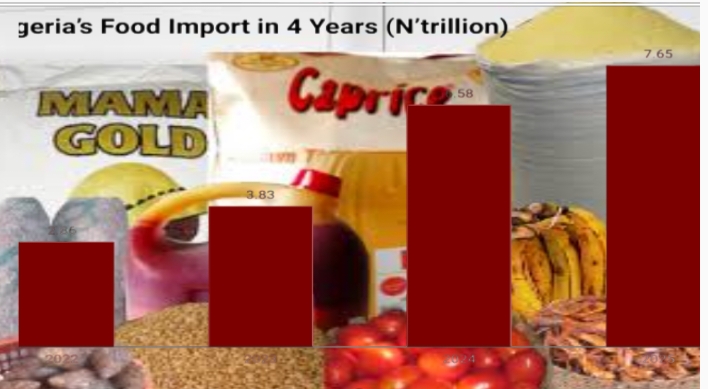
According to the Data from the National Bureau of Statistics (NBS) shows that Nigeria spent N7.65 trillion importing food and beverages from other nations in 2025, up 63 percent from N2.86 trillion in 2022.
The increment is driven by the 2024 import waiver policy implemented to ease soaring food prices.

Though the policy helped to drive food inflation down from 40.8 in June 2024 to single-digit in January 2025, it however caused losses for farmers.
“We need to look for more sustainable measures to increase food production because importation is not sustainable,” said Tunde Banjoko, Agric president of the Lagos Chamber of Commerce and Industry (LCCI), in an interview with Businessday.
It also puts a lot of pressure on foreign exchange.
So rather than importation, we should be talking about how to export,” Banjoko added.
In 2023, Nigeria spent N3.83 trillion on food imports, with the figure peaking in 2025 to mark the highest level within the period.
Of the imported food commodities in 2025, about N1.34 trillion was used for importing food for household consumption and roughly N2.09 trillion was spent importing food for industrial purposes. The 2025 household consumption bill is more than double the amount expended for the same purpose in 2022 – N529.4 billion.
Experts say, no nation can survive entirely on importation. Recent data from the United Nations Comtrade show that Nigeria spent roughly N51 billion on rice import in 2024, just when the import waiver policy was kicking off. Today, many rice mills have shut down due to inability to compete with rising costs of production and low market.
Expert further said the market became saturated with imported rice, which was cheaper than locally produced rice, forcing millers to sell at a loss.
“It was a disaster. The cost of production is high, so there was no way we could sell at the same price as imported rice,” he said.
He also urged for a state of emergency on farm inputs like fertilisers as prices have doubled in the last one year. “The government should put a state of emergency on inputs like fertiliser to avoid a repeat of what we are seeing today,” he said.
Similarly, Gideon Negedu, former executive secretary of the Fertiliser Producers Suppliers Association of Nigeria, emphasised that Africa’s most populous nation cannot remain dependent on food importation because it is not sustainable.
“The current food import policy will not be a sustainable solution to stabilise food prices because global food prices will surge,” analysts told Businesssday.