
By Lanre Shodimu

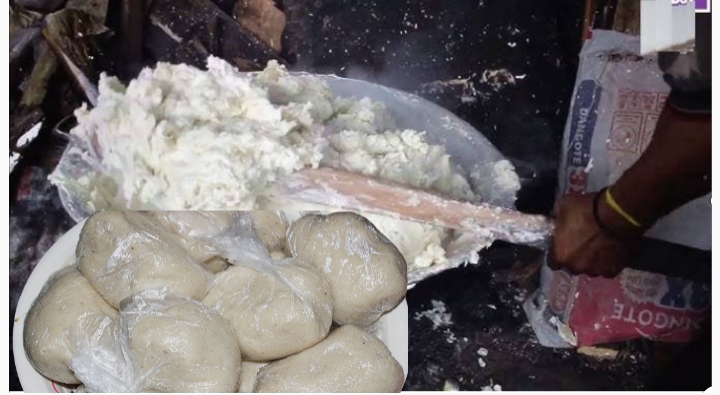
Fufu, is a local delicacy in southern Nigeria and a derivative of cassava, about one of the most popular delicacy which in local palance is referred to as “swallow”.
While it’s so common in Southern Nigeria , it is however called Fufu in Yoruba , and Akpu in Igbo, while the Calabar and others call it fufu akpan or ekpo. No doubt, it’s a delicacy that’s difficult to resist, especially with the availability of good soup.
However , according to a report made by The Guardian Online of February 28th, 2026, titled “Red alert as danger of consuming Fufu heightens”.

The report stated that despite the wide acceptance of fufu, it is becoming a serious health risk due to several sharp practices in its processing, which are inimical to health. For instance, investigations showed that some of the producers intentionally add harmful substances to soften soaked cassava.
According to the report, Fufu processing typically involves key steps – peeling, washing, soaking, fermenting and filtering. Normally, the period of soaking and fermentation takes between three to four days, depending on the weather, but most times, takes more than four days, leading to producers’ cunning ways of forcing soaked cassavas to soften.
Investigations by Guardian online publication revealed that substances like detergents, bleach and chemicals among others are usually applied to force soaked cassava to ferment within two days, unknown to hapless consumers.
According to the report, one of the fufu producers, Mrs. Ajayi, who confirmed this heinous act, said she abhors the practice of mixing dangerous chemicals with cassava due to her conscience, adding that her faith doesn’t permit her to engage in any act that’s capable of causing harm to fellow humans for whatever reason.
“It is real that some producers, for the sake of making quick money, do fast-track the process that is supposed to take four or five days to only one day by soaking the raw cassava with detergents of their choice or bleach.
“This invariably enables the cassava to become soft by force. Consumers who are oblivious of the inherent danger in what they buy and consume simply fall victim of these producers and entrapped.
“I pity these consumers who do not know the combination of what makes the food item they are swallowing and the grave consequences of this, something they bought with their own money,” She said.
A Medical Officer, Festus Peter Adekunle said the implication of applying detergents and bleach to soften cassava has a very grave consequences on human health.
“Such mixture with cassava when consumed is capable of causing cancer or breaking down of red blood cells in the body. Infected victims would develop the symptom of emaciating, which could be misinterpreted to normal ailment, not realising that it is the resultant effect of eating fufu contaminated with detergents and bleach.
“The extent of the damage to the body of the victims is unimaginable. My unambiguous comment on this dangerous move is that those producers are committing a heinous crime with devastating effect to the bodies of consumers of their harmful product.
“My word of advice is that these inhuman attitudes should be stopped as this misdemeanor cannot be less interpreted to selfish attitude simply because of money and they cannot quantify the damage they are causing to the bodies of their unfortunate victims.
“I just wonder the kind of money they are craving for, that they have to put the lives of their fellow humans into jeopardy. As a medical officer, I can unequivocally say that the end does not justify the means as the money they are chasing to the detriment of innocent lives is the type of money they want to get by all means, not minding whose ox is gored.”
The report stated
The report further stated that Prof. Mojisola Adeleye in the course of interview with Tosin Omolaja of NAFDAC on World Safety Day, warned Nigerians to be wary of what they consume, to avoid using less drugs, while she equally advised that food safety is a shared responsibility of the government, producers and consumers.
“Food safety is important and it is the responsibility of NAFDAC to ensure that the food we eat is safe. It is imperative that food must be safe for consumption and any food presented to consumers must be safe and honestly and genuinely prepared.
“We expect that every producer should produce what is safe for consumption and must be careful that dangerous and contaminated foods that will lead to ill health are not presented to the public for consumption. We also expect that consumers should ensure that what they eat is properly processed.”
Also reacting, according to the report, the Managing Director, ACCAPPOCCO, Global Services Limited, an organisation that offers Health, Safety and Environmental (HSE) training and consultancy, Dr. Valentine Okpone Ottis described the practice as criminal. “The act of mixing cassava with detergents and bleach is criminal. It is inappropriate to mix inorganic with organic.”
He further explained that inorganic elements are not expected to be consumed because of their carcinogenic and toxicity effects in the human system. “Biomas regarded as inorganic elements, are not for consumption, hence, whoever sees any person indulging in the practice of mixing cassava with detergents and bleach should be reported to the law enforcement agents.
“This is where advocacy also becomes very important and this is where the government needs to come in powerfully. There is advocacy at the industrial scene, but the government needs more at the public scene. At the local level, there are some products that are dangerous to eat. This is where quality control also becomes imperative that would be critical about the production of what people eat.
Further more, Professor John Adebayo Oyedepo of Institute of Food Security, Environmental Resources and Agricultural Research, University of Agriculture, Abeokuta in his comment blamed the malpractice on the inefficiency of government policies.
“What we have discovered in the policies in Nigeria is that most of the policies are not efficient or they get to a particular point in the course of implementation and somersault.
“Organisations such as NAFDAC in addition to paying attention to industrial sector should also focus on hotels, local and individual producers. Who knows those that are producing food items at their backyards or within their houses and push them to the market for public consumption? This is where there is work for environmental sanitation agencies and NAFDAC who are expected to increase their scope of duty by going closely to monitor every food producers.
“Due to the state of the economy, everybody wants to survive and these set of people go to the extreme by mixing cassava with detergents and bleach and push out the product as meal for people to consume, which invariably cause terminal diseases like cancer and the rest of them.
“My advice is that there is need for policy review from time to time. For instance, what is the scope of NAFDAC in the area of food, drugs and other areas they are supposed to cover? I believe that the area of food monitoring should also be extended to the local council involvement. Agencies like NAFDAC should have their offices at the local council headquarters.
“One wonders the role of local councils that are supposed to be in charge of grassroots, identify the problems there and solve them. In the developed countries, it is the local council or municipal Council that are in charge of problems in question. They know where the faults are and they fix them on time.
“This is the reason I am emphasising on policy review from time to time and the need to make them efficient,” he said.
On his part, the Executive Director, Drugfield Pharmaceuticals Limited, Afolayan Kayode Emmanuel, said the culprits are hiding under bad implementation of policy binding on food items.
“The government should be passionate about the life of the people and should be able to put a good regulation in place and ensure that those regulations and policies are effectively policed.
“When we talk about the policies and the regulations being policed, this should not be for pecuniary reasons whereby those enforcing the policies or regulations are out for what they can selfishly gain and play down on the life of the people, the policy and the regulation are supposed to protect.
“When the people are aware that offenders will be penalised, they will sit up and begin to have more value for life. When people are conscious of safety in all they do or produce in spite of the economy, they will focus on the quality of the products and not just on profits,” he said.
The Guardian online publication is a wake up call for all Nigerians to be conscious of what they consume. Since production of fufu may not formally fall under any regulation , now that the media has exposed the danger to which some unscrupulous Nigerians expose Nigerians to, then the Government needs to do more to empower NAFDAC to go into the nooks and cranies of villages and wherever the food is produced and ensure the right thing is done.
Farmers associations can also be empowered to assist the government in identifying those behind the unwholesome practices not only as it relates to Fufu but in preparation of other food items .