



Nigeria @ 65

“Then, everyone were encouraged to cultivate their back gardens intensively and to keep chickens, whose eggs and meat would provide an important source of protein and whose droppings could be used as fertiliser – Report
By Lanre Shodimu
Nigeria @ 65, but its agricultural journey predates its 65 years of nationhood. Reminiscing on the contribution of agriculture to Nigeria’s economy in the 60s attests to the fact that agriculture once played a pivotal role in our national growth and development. From the cocoa plantations in the Western region to the groundnut pyramids of the North, and down to the oil palm plantations of the Eastern region, Nigeria was a beehive of agricultural activities.

The iconic Cocoa House in Ibadan, which is now 60 years old, was once the tallest building in West Africa. The free education initiative embarked upon by the Western Government, along with other developmental projects at the time, were financed through agricultural proceeds. While the Cocoa House in Ibadan is a beautiful edifice to behold, it also serves as a poignant reminder that Nigeria, as a nation, missed the path to agricultural greatness and food sufficiency when it discovered oil in its shores.
According to CBN ECONOMIC & FINANCIAL REVIEW journal @ dc.cbn.gov.ng, as if that during “the Nigerian civil war of 1967-70, agriculture dominated Nigeria’s economy, contributing some 53 per cent to GDP in 1965.
It stated further that by 1984, its percentage share had almost halved. The pattern of Nigeria’s economic structure changed dramatically during the era of Independence. However, while agriculture’s percentage share of GDP between 1965 and 1984 diminished, the absolute value of Agriculture’s contribution to GDP increased from $2,221 million to $19,832 million. This suggests that although there was a relative decline in agriculture, it may not necessarily have been absolute. However, it is difficult to say whether the rise was due to a real increase in the value of agricultural products or whether inflation in the agricultural sector was so high that it masked the stagnation that many believed was occurring. Studies conducted in rural Nigeria reveal an average annual inflation rate of 30 per cent in the agricultural sector for 1970-80. This is far higher than the average annual rate of inflation for the nation as a whole, which was 18.2 per cent for 1970-78.
SOME SPECIFIC POLICIES TO BOOST AGRICULTURAL OUTLOOK
The journal also acknowledged several initiatives at boosting since 1970 to bring new technology to the small farmer. These schemes according to the publication are in addition to the Agricultural Development Projects (ADPs) and River Basin Development Authorities (RBDAs). Although their methods of operation have varied, the objective of self-sufficiency in food has remained the same.
It further stated that (RBDAs). Although their methods of operation have varied, the objective of self-sufficiency in food has remained the same, citing examples such as
THE NATIONAL ACCELERATED FOOD PRODUCTION PROGRAMME
In 1973, the National Accelerated Food Production Programme (NAFPP) was launched. This concentrated on the distribution to small holders of packages of information and raw materials designed to improve the produc.;tion of wheat, sorghum, millet, rice, maize and cassava. To ensure that farmers were able to use the packages, a dense network of extension workers and agro-service centres was set up. In theory, the scheme had much to offer, but in practice, it was of limited benefit as the government ceased to contribute adequate funds and hence the system collapsed.
OPERATION FEED THE NATION (OFN)
In 1976, unnerved by the vast amount of foreign exchange leaving Nigeria to pay for increasing quantities of imports, the government introduced Operation Feed the Nation (OFN). This was a hurried initiative which was not clearly thought out by a regime anxious to make a breakthrough. Once again. the objective, as the name suggests, was self-sufficiency in food. Subsidis.ed supplies of fertilisers, seeds, insecticides and pestcides, among other items, where provided. Everyone according to the report was encouraged to cultivate their back gardens intensively and to keep chickens, whose eggs and meat would provide an important source of protein and whose droppings could be used as fertiliser. The necessary supplies were to be distributed by thousands of students who were paid to do this during their long vacation. However, success was limited as ~ome two-thirds of the entire government allocation in the first year of the OFN programme was spent on student wages, leaving little for the farmer. Supplies were not sustained, efforts were concentrated on the establishment of OFN farms, rather than on smallholders, the timing was wrong among other things and consequently, the progr_amme collapsed.
THE GREEN REVOLUTION:
The report further stated that in 1983, with the return of civilian rule. the rem.ains of OFN were cancelled and replaced with a much more ambitious and highly organised system run by the National Council for the Green Revolution. It was operated on Green Revolution principles, that is, the use of high yielding varieties of seed, high inputs offertiliser. irrigation, etc. The new system offered rene~ed hope for farmers but like its predecessors. this too took ill through bureaucratic problems because people in senior administrative positions had little or no connection with those working in the field and so the programme died a premature death when a new government came into power. The approaches to developing Nigerian agriculture in general term have not been lacking in imagination. In almost every case, however, success has been minimal because the government has failed to maintain consistency in its investment in agriculture.
The Path to Re-Embracing Agricultural sector
In the wake of Minister of Agriculture, Mr. Kyari’s revelation about Nigeria’s annual food import bill of $10 billion and soaring food prices, threatening millions with hunger and poverty amidst a rising population, concerted efforts from both private and public sectors are needed to boost Nigeria’s agricultural sector.
The 2025 federal budgetary allocation to agriculture stood at a meagre 1.5 per cent (N826.5 billion or $533 million), just like in previous years, proving that investment and state support remain insufficient and as reported Traditional credit systems often suffocate farmers due to high-interest rates and stringent loan conditions, discouraging expansive farm activities and mechanisation.
However, the Irrigate Nigeria Project(INP) reported by Nigeria media and Gov. Bala Mohammad of Bauchi State commended President Bola Tinubu over execution of viable agriculture, economic and social infrastructure development projects in the country is a move at embracing agriculture once again.
The INP is being implemented by the National Agency for Science and Engineering Infrastructure (NASENI) under the Renewed Hope Infrastructure Development Fund (RHIDF) of the Bola Tinubu administration as was reported by News Agency of Nigeria.
Mohammed described the INP project as a structured agricultural intervention that prioritised inclusivity, accountability and long time economic impacts for the country. According to him,
Mohammed said that Tinubu was showing to Nigerians that it was time for governance through execution of impactful projects.
He said this on Saturday during the inauguration of the Irrigate Nigeria Project (INP) in Gamawa, headquarters of Gamawa Local Government Area of the state.
The INP is being implemented by the National Agency for Science and Engineering Infrastructure (NASENI) under the Renewed Hope Infrastructure Development Fund (RHIDF) of the Bola Tinubu administration.
Mohammed described the INP project as a structured agricultural intervention that prioritised inclusivity, accountability and long time economic impacts for the country.
“The Irrigate Nigeria Project if implemented as designed will have a multiplying effect across the agriculture value chain both vertically and horizontally.
“It will drive knowledge transfer, introduce advanced technologies and distribute wealth equitably ensuring that even the most vulnerable members of our society benefit from this transformation.
“This initiative will not only transform Gamawa but will also serve as a model for other regions across Nigeria.
“What the President is bringing is what I think any leader in Africa should bring and I’m really proud of him for doing this because certainly, it is showing that it is just time for governance,” he said.
Also , Business day online publication of May 30, 2025, in it’s mid term review of President Bola Ahmed Tinubu’s performance in the Agricultural sector noted that
“One of the first major acts from the Tinubu administration was to declare a state of emergency on food security. It wasn’t just symbolic—the Ministry of Agriculture was renamed the Ministry of Agriculture and Food Security, signalling an intent to focus squarely on what was becoming a national crisis: food availability and affordability.
The report further acknowledged backingthe intent with ₦100 billion Agricultural Development Fund, designed to address the perennial financing woes that have crippled smallholder farmers for decades. The president also launched a Dry Season Farming Initiative, with $134 million in financing from the African Development Bank, targeting 500,000 hectares for the cultivation of some arable crops.
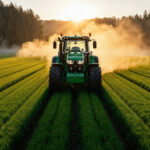
Also, of significant importance is efforts to modernise the system as Nigeria signed a deal with John Deere to deliver 2,000 tractors annually over five years. There was also the ambitious Green Imperative Programme with Brazil—a $1 billion mechanisation partnership aimed at equipping farmers and building capacity.
Many smallholder farmers according to the report still operate with hoes and cutlasses. The 10,000 tractors promised under various schemes are a welcome start, but Nigeria needs closer to 70,000 tractors to truly mechanise at scale. Many of those distributed so far are still concentrated in politically connected hands, not in the communities where they’re most needed.
Access to credit also remains a bottleneck. The ₦100 billion fund, while a step forward, hasn’t yet broken the vicious cycle of collateral requirements, delayed disbursements, and high-interest lending. Farmers in rural Oyo, Kebbi or Nasarawa are not necessarily feeling this “financial inclusion”.
President Tinubu’s broader economic reforms—namely, the removal of fuel subsidies and the floating of the naira—were aimed at stabilising the macroeconomy. But for agribusiness, the short-term pain has been intense according to the report.