

By: Simeon Shodimu

As inflation and rising transportation costs continue to push food prices beyond the reach of ordinary Nigerians, millions of low-income households are being forced to abandon nutritious meals for survival diets built around carbohydrates. Across homes in Lagos, Ogun, Kano, Enugu, and other parts of the country, meat, fish, eggs, and other vital sources of protein are gradually disappearing from cooking pots, raising fears of a worsening malnutrition crisis among children and vulnerable families.

Punchonline paints a glommy situation of Nigeria’s food crisis and the impending danger of malnutrition and starvation over rising costs of beef in the market. From struggling mothers rationing eggs and ponmo to cattle dealers battling soaring costs and debts, the nation’s deepening economic hardship is exposing a silent nutritional emergency with grave public health implications.
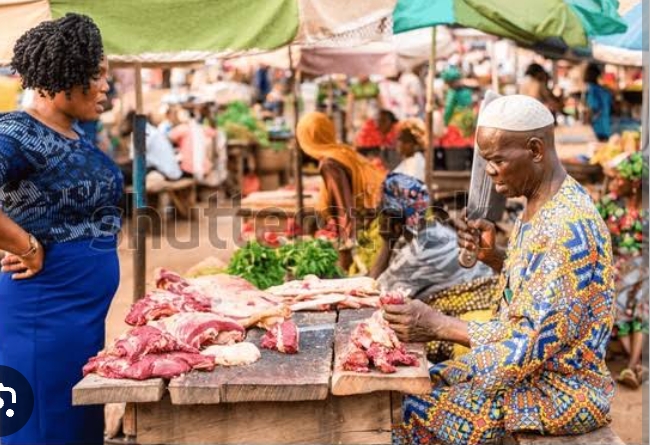
Under the scorching afternoon sun in Isheri, the bustling border community between Lagos and Ogun States, 37-year-old vegetable seller, Olaide Alarape, stood quietly in front of a meat stall at Kara Market, clutching a few crumpled naira notes while calculating what her money could buy.
Around her, traders shouted prices above the noise of bargaining customers, but Alarape’s attention remained fixed on the small chunks of beef displayed on the wooden tables before her. The meat, once a staple in her family’s meals, had become painfully unaffordable.
For the mother of three, feeding her children nutritious meals has turned into a daily struggle shaped by inflation, rising food prices, and declining purchasing power.
“It has been more than two months since I last bought meat,” she said with a weary expression. “There are times I cook without any animal protein because things are now difficult. The beef my children love has become three times more expensive.”
Like millions of Nigerians grappling with worsening economic hardship, Alarape has turned to eggs as a cheaper alternative to meat.
“When you ask for meat worth N2,000 now, they give you tiny pieces that cannot satisfy a family. I would rather buy eggs worth N1,000 and use them to prepare stew than buy meat worth N5,000 that won’t even last a day,” she lamented.

Her story reflects a growing reality across Nigeria, where the soaring prices of beef, chicken, turkey, fish, crayfish, and even eggs are pushing protein-rich diets beyond the reach of ordinary citizens.
Meals Without Protein
In Berger, another densely populated area of Lagos, 40-year-old washerwoman Nnena Victor has mastered what she calls “the art of stretching soup.”

Every evening, she serves meals to her four children with little or no animal protein. What used to be soups enriched with beef or fish have now become watery stews accompanied by garri, noodles, or yam.
“Before things became this costly, we used to eat meat properly several times a week. But now, meat has become like gold,” she said.
Victor explained that she now depends largely on eggs or cheap fish whenever she can afford them.
“If you buy meat worth N2,000 or N3,000 now, the quantity is too small. So I buy eggs once or twice a week instead. At least the children can eat something with protein,” she added.
Across major cities including Lagos, Ogun, Kano, Enugu, and Port Harcourt, many low-income families are making similar adjustments. Beef, fish, chicken, and dairy products have increasingly become luxury items reserved for special occasions.
Findings across markets reveal that a kilogram of beef now sells for N8,000 and above, goat meat costs over N10,000, while turkey and chicken range between N7,000 and N8,000 depending on size and location. Fish prices vary between N3,000 and N10,000, while a crate of eggs now costs more than N6,000, compared to less than N2,000 a few years ago.
Even crayfish, commonly used as an affordable protein supplement, has become expensive, with a paint bucket now selling between N12,000 and N18,000.
The consequences are increasingly visible in homes where families now prioritise stomach-filling carbohydrates over balanced diets, worsening Nigeria’s already alarming malnutrition burden.
Survival Before Nutrition
For 29-year-old single mother, Idayat Olayemi, protein-rich meals have become rare luxuries.
Living in Alagbole, Ogun State, she said she now buys ponmo or eggs occasionally because she must spread her limited income across rent, school fees, transportation, and feeding.
“Most times, we just eat whatever can satisfy hunger,” she admitted.
Similarly, Lagos-based hairdresser Toyin Alawode said rising prices have forced her family to abandon beef almost entirely.
“If you ask for meat worth N1,000 now, they will only give you three or four tiny pieces. So I prefer buying eggs or panla fish for my children,” she said.
Another mother, Rasaq Oluwakemi, explained how she improvises with eggs to make her children feel like they are eating meat.
“If I buy just two eggs, I mix and boil them inside nylon until they become firm, then slice them into tiny pieces for stew. That is how we manage now,” she said.
For many households, feeding has become an exercise in survival rather than nutrition.
A low-level civil servant, Olawunmi Hajarah, noted that stagnant salaries and rising living costs have made balanced diets nearly impossible.
“School fees, rent, electricity, and transport are competing with food. Nutrition now comes secondary because survival comes first,” she said.
Why Beef Prices Are Skyrocketing
At the Oko Oba Abattoir, Kara cattle market, and Mile 12 market, cattle dealers and butchers blamed the removal of fuel subsidy, transportation costs, insecurity, and expensive animal feed for the unprecedented rise in beef prices.
The Financial Secretary of the Cattle Dealers Association of Nigeria, Alhaji Isa Muhammed, explained that the economics of the cattle business changed drastically after fuel subsidy removal.
“Before subsidy removal, the biggest cow was not more than N700,000. Today, some cows cost between N2.5 million and N3 million,” he said.
According to him, transporting cattle from Maiduguri to Lagos previously cost about N500,000 per truckload, but transport expenses have surged significantly due to higher fuel prices.
Animal feed prices have also risen sharply.
“Feed that sold for around N1,000 per bag now costs about N18,000,” Muhammed disclosed.
The Chairman of the Cattle Dealers Association in Isheri-Olofin, Ogun State, Alhaji Kolo Muhammed, corroborated the claims, adding that transporting a single cow from the North to Lagos now costs about N120,000 compared to N50,000 previously.
“The smallest cows now sell for N600,000 or N700,000, medium sizes for over N1.5 million, while the biggest can cost over N3 million,” he explained.
The dealers lamented that many butchers and traders are drowning in debt as consumers can no longer afford to buy meat in substantial quantities.
Customers Beg for N500 Meat
At Mile 12 market, butcher Kehinde Alabi said customers now plead to buy meat worth as little as N500.
“People beg us because things are hard. Some say their children have not eaten meat in weeks,” he said.
Another butcher, Musiliu Adepoju, said customers who once bought sizeable quantities now request tiny portions for entire family meals.
“People price meat and walk away because they cannot afford it anymore,” he added.
The shrinking presence of meat in Nigerian homes is no longer just a household adjustment; experts warn it is becoming a national health emergency.
Experts Warn of Hidden Hunger
Nutritionists and public health experts say the growing inability of Nigerians to afford animal protein could trigger widespread protein deficiency and worsen the country’s malnutrition crisis.
Protein, regarded as an essential nutrient for growth, immunity, and body repair, is particularly important for children, pregnant women, and vulnerable populations.
According to the United Nations Children’s Fund, malnutrition contributes to nearly 45 per cent of deaths among children under five in Nigeria. The country also carries the highest burden of stunted children in Africa and the second highest globally.
The 2023–2024 National Demographic and Health Survey revealed that nearly 40 per cent of Nigerian children under five are stunted, while eight per cent suffer wasting.
In January 2026, the United Nations Office for the Coordination of Humanitarian Affairs warned that about 35 million Nigerians risk acute hunger this year.
Similarly, Médecins Sans Frontières disclosed in its 2025 Country Activity Report that it recorded its highest malnutrition admissions in recent years, treating over 440,000 children across its operations in Nigeria.
A former Director of Nutrition Services in Osun State, Mr James Oloyede, warned that inadequate protein intake among children could have devastating long-term effects.
“When children are malnourished in early childhood, it affects brain development and intellectual growth. There will be more cases of stunting, wasting, underweight children, and weakened immunity,” he explained.
He further warned that poor maternal nutrition could worsen pregnancy outcomes and perpetuate an intergenerational cycle of malnutrition.
Chief Dietitian and Nutritionist, Olufunmilola Ogunmiluyi, also stressed that animal proteins contain essential amino acids and nutrients necessary for healthy growth and metabolism.
“When families are forced to abandon nutrient-dense foods for cheap carbohydrates, the result is hidden hunger — people may feel full, but their bodies lack the nutrients needed for healthy living,” she said.
As inflation continues to erode incomes and nutritious foods disappear from household menus, millions of Nigerians now face a dangerous reality where survival has overtaken balanced nutrition — a crisis experts fear may leave long-lasting scars on the nation’s health and future generations.