



By Jide Akinseye

An agric-fintech firm, CropCura has advocated for a structure that provides structured credit to farmers based on reliable data.
The co-founder of CropCura, Victor Onyekachukwu, made this known in a thought leadership article he wrote, and shared with The PUNCH recently.
CropCura is a credit data layer for agricultural lending.
Through its system, farm-level activities are captured, validated, and structured into traceable indicators tied directly to production cycles and farm performance. Rather than estimating creditworthiness based on limited paperwork, lenders gain visibility into real production data.
In his submission, Onyekachukwu stated that despite agriculture being a significant contributor to Nigeria’s GDP, access to formal financing remains critically low.
This financing gap runs into billions of dollars annually. It represents not only a development challenge but also a missed commercial opportunity for financial institutions seeking sustainable portfolio growth. The issue is simple but structural. Traditional credit scoring models were not designed for farmers operating in largely informal environments. Many smallholder farmers do not have documented financial histories, structured income statements, or verified production records. For lenders, this creates uncertainty. Without dependable data, credit decisions are based on assumptions rather than evidence. The result is conservative lending practices, limited portfolio expansion, and continued exclusion of capable farmers. At the heart of the challenge is a data problem.
“This is where CropCura is building a different approach. CropCura focuses on providing the credit data infrastructure required to make agricultural lending safer and more profitable. Instead of attempting to force farmers into traditional credit frameworks, the platform captures and translates real farm activities into structured, bank-ready credit insights. He said
He further made it known that “For financial institutions, the question is not whether agriculture is important. It clearly is. The question is how to lend into the sector while managing default risks and protecting balance sheets.”
He added that with improved credit visibility, banks can expand their agricultural loan books while maintaining stronger risk controls.
He explained, “Nigeria’s agricultural lending market holds significant untapped potential. Many financial institutions already maintain some form of agricultural portfolio.
However, the real opportunity lies in safely extending services to the millions of farmers who remain excluded from formal finance. When risk becomes measurable rather than speculative, expansion becomes more viable.
“This financing gap runs into billions of dollars annually. It represents not only a development challenge but also a missed commercial opportunity for financial institutions seeking sustainable portfolio growth. The issue is simple but structural. Traditional credit scoring models were not designed for farmers operating in largely informal environments. Many smallholder farmers do not have documented financial histories, structured income statements, or verified production records. For lenders, this creates uncertainty. Without dependable data, credit decisions are based on assumptions rather than evidence. The result is conservative lending practices, limited portfolio expansion, and continued exclusion of capable farmers. At the heart of the challenge is a data problem.
“This is where CropCura is building a different approach. CropCura focuses on providing the credit data infrastructure required to make agricultural lending safer and more profitable. Instead of attempting to force farmers into traditional credit frameworks, the platform captures and translates real farm activities into structured, bank-ready credit insights.
“For financial institutions, the question is not whether agriculture is important. It clearly is. The question is how to lend into the sector while managing default risks and protecting balance sheets.”
He added that with improved credit visibility, banks can expand their agricultural loan books while maintaining stronger risk controls.
He further explained that “Nigeria’s agricultural lending market holds significant untapped potential. Many financial institutions already maintain some form of agricultural portfolio. However, the real opportunity lies in safely extending services to the millions of farmers who remain excluded from formal finance. When risk becomes measurable rather than speculative, expansion becomes more viable.r
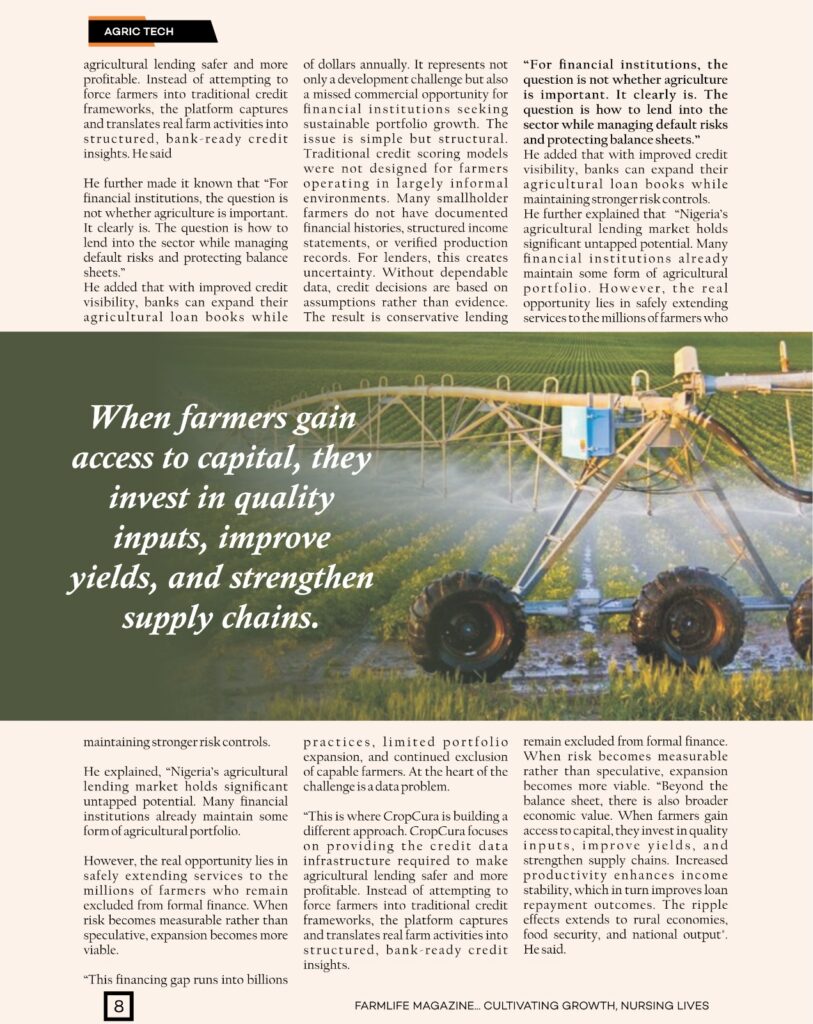
“Beyond the balance sheet, there is also broader economic value. When farmers gain access to capital, they invest in quality inputs, improve yields, and strengthen supply chains. Increased productivity enhances income stability, which in turn improves loan repayment outcomes. The ripple effects extends to rural economies, food security, and national output”. He said.