





By Simeon Shodimu

Nigeria’s drive toward food security and inclusive economic growth is taking a new direction as the Federal Government moves to reposition the country’s cooperative and agricultural sectors through financial innovation, digital transformation and agribusiness development.

At the centre of the new strategy is a bold proposal to establish the Cooperative Bank of Nigeria alongside a nationwide digital identity framework for cooperative societies and their members — reforms government officials say could unlock financing, improve transparency and deepen grassroots economic participation.
The Minister of State for Agriculture and Food Security, Aliyu Sabi Abdullahi, unveiled the plans in Lagos during the South-West Zonal Engagement of the Ministerial Advocacy Tour on Cooperative Bank Share Capital Mobilisation, Sensitisation and Cooperative Sector Digitalisation Drive.
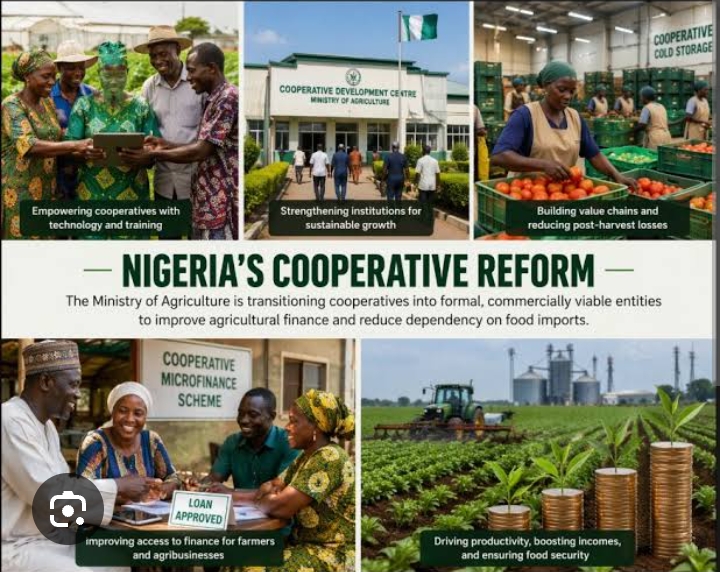
According to the minister, the initiative represents a major attempt to modernise Nigeria’s cooperative movement and create a more structured financial ecosystem capable of supporting millions of farmers, artisans, traders, women, youth, Small and Medium Enterprises (SMEs) and Persons with Disabilities (PWDs).
“For too long, the cooperative movement in Nigeria has operated without a dedicated and structured financial institution that truly understands and reflects cooperative realities and aspirations. This initiative seeks to change that narrative,” Abdullahi stated.

The proposed Cooperative Bank of Nigeria is expected to function as a specialised financial institution tailored to the realities of cooperative societies across the country. Unlike conventional banks that often exclude small-scale rural operators through stringent lending conditions, the new institution is designed to provide affordable and accessible financial services to grassroots economic actors.
Under the proposed ownership structure, cooperative societies, unions and federations will control 65 per cent equity in the bank, while private and institutional investors will hold 30 per cent. Employees of the bank and affiliated cooperative enterprises will own the remaining five per cent.
Abdullahi explained that the Federal Government would not directly fund the bank but would instead provide policy support, regulatory facilitation and stakeholder coordination to ensure its successful take-off.
Beyond financing, the government is also pushing for a digital overhaul of the cooperative sector through the introduction of a Cooperative Verification Number (CVN) for registered societies and a Cooperative Members Identification Number (CoopID) for individual members.
The minister said the digital identity system would help eliminate fraudulent cooperative societies, improve accountability, strengthen investor confidence and integrate cooperators into the formal economy.
According to him, both systems would be linked to Nigeria’s National Identity Number (NIN) database to ensure harmonisation with national data systems and enhance traceability within the sector.
The reforms are also expected to stimulate investments in cooperative housing, agro-processing, transportation, logistics, retail and digital platform services through the proposed Cooperative Trust and Investment Society of Nigeria (CoopTrust).
While government officials focused on financing and institutional reforms, stakeholders in the private sector used the occasion to call for a deeper transformation in the country’s agricultural mindset.
At the Xtralarge Agriwealth Revolution Summit in Lagos, the Group Managing Director of Xtralarge Farms & Resorts, Moji Davids, argued that Nigeria’s agricultural challenge is no longer the shortage of farmers, but the absence of agripreneurs capable of building profitable enterprises across the value chain.
According to her, many Nigerians already engaged in farming remain trapped in poverty because agriculture is often treated merely as subsistence activity rather than a structured business.
“We don’t need many more farmers. We already have enough farmers in the industry. They say food security, food security, but is there any day you wake up and go to the market and you don’t find food?” she said.
Davids stressed that the future of agriculture lies in value addition, processing, branding, logistics, market access and agribusiness management rather than primary production alone.

Her comments reflect a growing shift within Nigeria’s agricultural sector where policymakers and private investors are increasingly emphasising commercial agriculture, agro-industrialisation and value-chain development as pathways to wealth creation and employment generation.
Analysts say the convergence of cooperative financing reforms and agripreneurship advocacy could significantly reshape the sector if effectively implemented.
With rising food prices, unemployment and limited access to finance remaining major concerns for millions of Nigerians, stakeholders believe that stronger cooperatives, digital transparency and agribusiness-driven investments may provide a more sustainable framework for rural development and national food security.
As Nigeria searches for lasting solutions to agricultural productivity and economic inclusion, the emerging consensus appears clear: the future of farming may depend less on increasing the number of farmers and more on empowering a new generation of agripreneurs backed by strong cooperative institutions and accessible financing.